
Tag

Asteroid Impacts

All articles tagged with #asteroid impacts

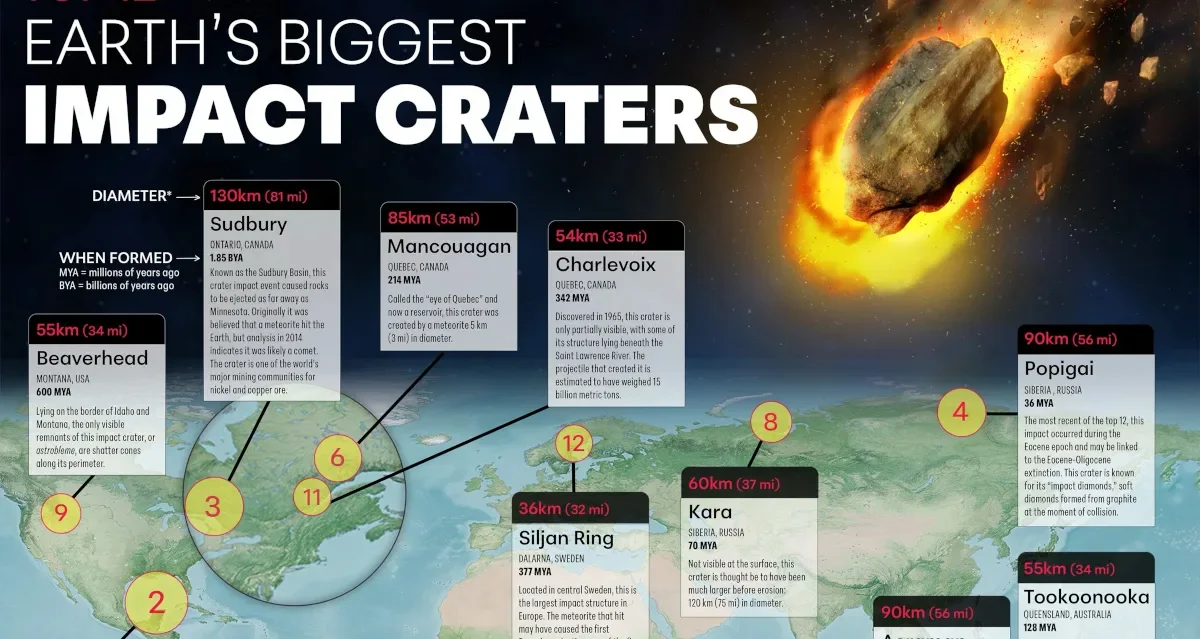
Earth’s Largest Impact Craters: The 12-Chart Global Snapshot
science27 days ago

Earth’s Largest Impact Craters: The 12-Chart Global Snapshot

Visual Capitalist maps the 12 largest confirmed Earth impact craters, led by Vredefort (≈160 km) in South Africa and Chicxulub (≈150 km) in Mexico; other entries include Sudbury, Popigai, Acraman, Manicouagan, Morokweng, Kara, Beaverhead, Tookoonooka, Charlevoix, and Siljan. The article notes that crater size doesn’t always predict devastation—impact energy, velocity, angle, and composition are crucial—with Chicxulub likely releasing over 100 million megatons of TNT and triggering mass extinction, while older craters like Sudbury and Morokweng formed long before complex life. Many ancient craters have eroded away, making these 12 especially valuable for studying Earth’s violent history, and some preserve significant mineral deposits and geology from their cosmic origins.

"Scientists unite to safeguard Earth from asteroid threats on Asteroid Day"
science-and-technology2 years ago

"Scientists unite to safeguard Earth from asteroid threats on Asteroid Day"

Asteroid Day, recognized by the United Nations and celebrated on June 30, aims to raise awareness about the risks of asteroid impacts. The initiative, led by physicist Stephen Hawking and others, calls for the detection and tracking of Near-Earth Asteroids, a rapid increase in discovery efforts, and global adoption of the event. Various activities and events are being held worldwide to mark the occasion, including discussions, lectures, and live streams.

science-and-technology2 years ago

Countdown to Asteroid Day 2023: History, Significance, and Celebrations

Asteroid Day 2023 is a global awareness movement focused on educating people about asteroids and the importance of protecting our planet from potential impacts. This year's events include online and worldwide activities, with NASA's Jet Propulsion Laboratory creating a webpage filled with educational resources. The significance of June 30 is highlighted, as it marks the anniversary of the Tunguska Event in 1908, the largest modern-day impact event that devastated a large area in Russia. Efforts by organizations like the United Nations and the B612 Foundation are working towards developing defensive capabilities and improving asteroid detection. Key highlights in planetary defense include the establishment of NASA's Planetary Defense Coordination Office, interagency exercises, the approval of the NEO Surveyor space-based telescope mission, the successful impact of NASA's DART mission, and the active participation of citizen astronomers in making real-time observations. The article emphasizes the need for continued vigilance and action to prevent catastrophic events like the extinction of the dinosaurs.