Tag

Assembly Theory

All articles tagged with #assembly theory

science1 year ago

Unraveling Complexity: The Origins of Life's Building Blocks

The article discusses theoretical physicist Sara Imari Walker's work on Assembly Theory, a framework exploring the rise of complexity in lifeless systems and the fundamental differences between living and non-living matter. Walker's theory emphasizes the role of information and complexity in understanding life's unique properties, focusing on how complex structures emerge and persist. The conversation highlights the importance of measuring complexity and information in physical terms, and the potential of Assembly Theory to offer new insights into life's evolution and existence in the universe.
science2 years ago

"Scientists puzzled by controversial theory merging evolution and physics: Is it a solution in search of a problem?"

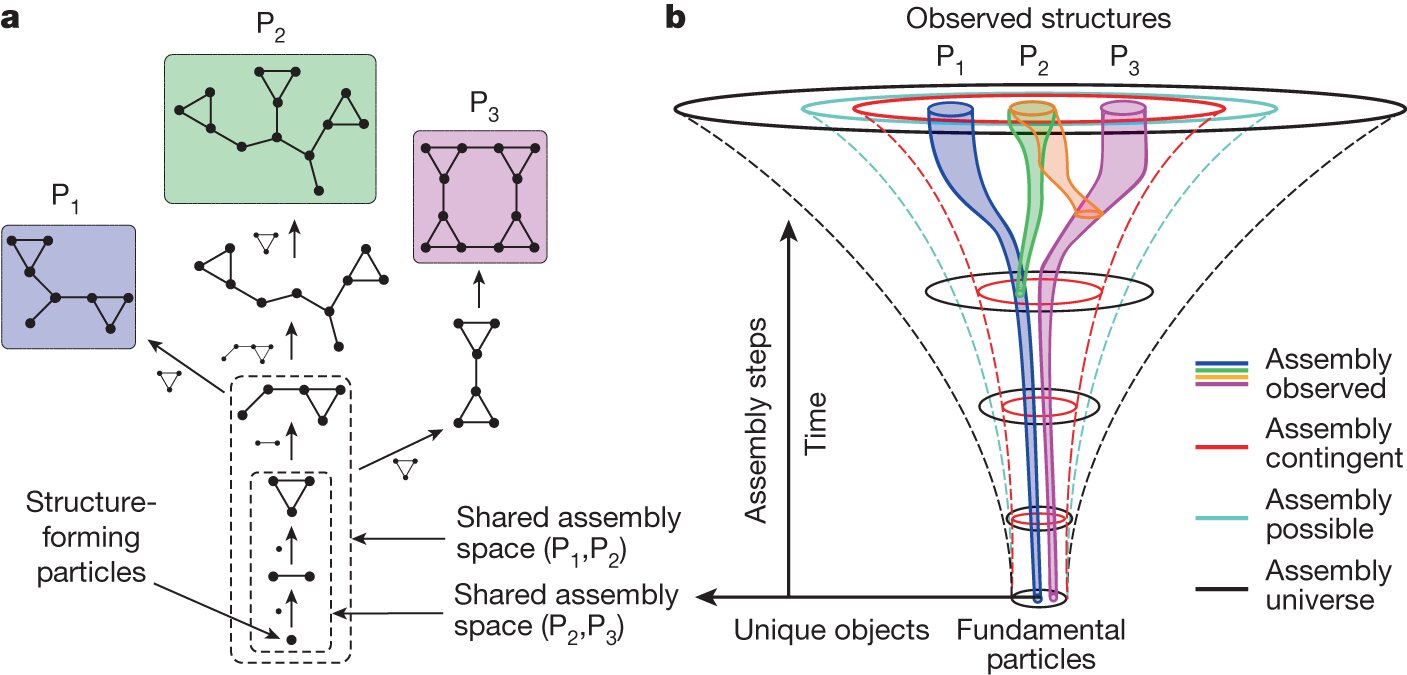
A paper titled "Assembly theory explains and quantifies selection and evolution" has sparked controversy among scientists. The authors claim their theory, which aims to bridge the gap between physics and biology, provides a new approach to understanding how complex biological forms can evolve. However, critics argue that the paper's claims of a conflict between evolution and the laws of physics are unfounded and reminiscent of creationist arguments. The theory attempts to quantify the complexity of objects and the likelihood of their evolution, but some scientists question its usefulness and argue that it addresses a problem that doesn't exist.

science2 years ago

"Unveiling a Revolutionary Theory: Matter's Role in Unraveling the Mysteries of Life"

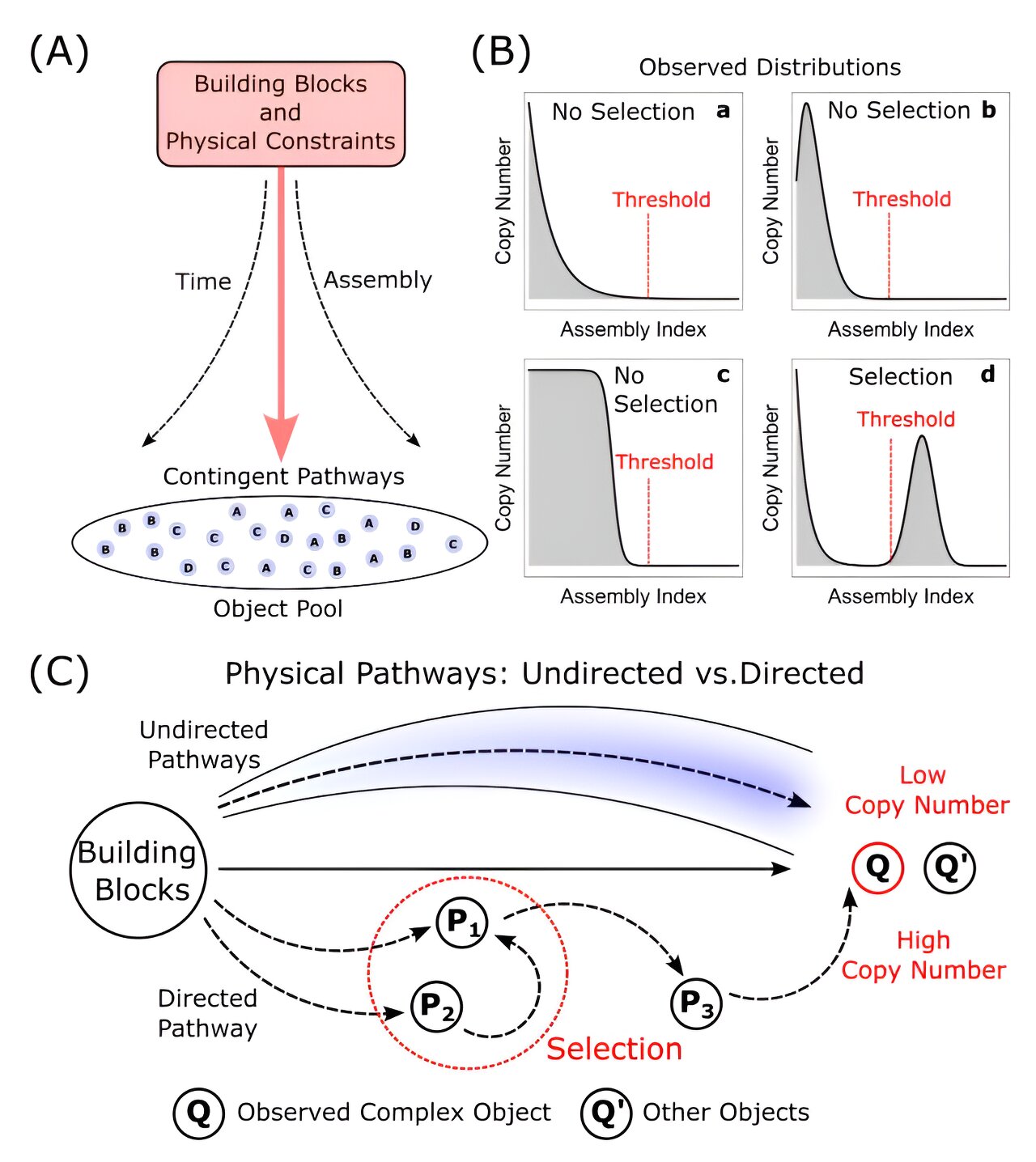
A new theory called Assembly Theory (AT) suggests that the assembly history of material objects is an essential property of all matter, challenging the current understanding of matter in physics. AT defines objects based on their capacity to be assembled or broken down using minimal paths, taking into account their evolutionary history. By quantifying an object's complexity and tracking the number of identical copies, AT distinguishes functional complexity from randomness and provides a framework for understanding how complexity emerges in both inorganic and organic systems. This theory has implications for bridging the gap between physics and biology and may offer insights into the emergence of life and the open-ended generation of novelty in both natural and human-engineered systems.

science2 years ago

"Testing a Groundbreaking Theory: Bridging the Gap Between Physics and Life in the Lab"

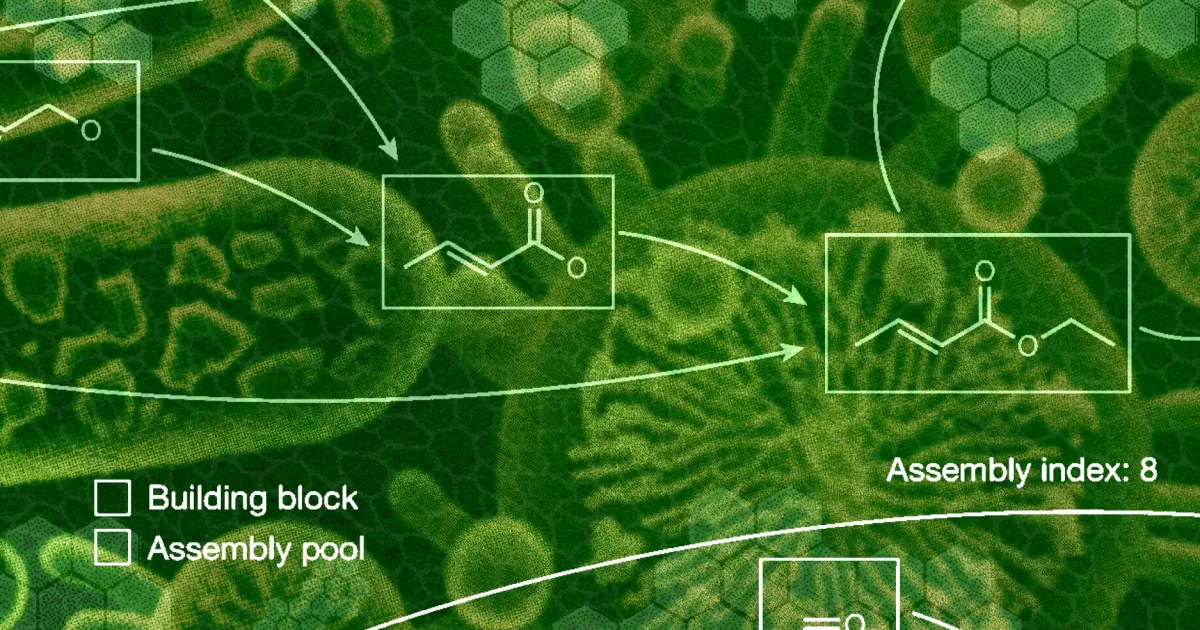
Researchers are testing a groundbreaking theory called assembly theory, which aims to explain the emergence of life from non-living matter. The theory proposes that complexity and information are key factors in understanding life, and it introduces the concept of an "assembly index" to quantify the minimal steps required to build an object. Laboratory experiments have been conducted to determine the assembly index of various molecules, showing that molecules associated with life require more complexity and information to assemble. The theory also offers insights into the origin of life and may have broader applications in understanding hierarchical construction and evolution.

science2 years ago

"Revolutionary Lab Testing Challenges Physics' Inability to Explain Life"

Physics has long struggled to explain the emergence of life, but a groundbreaking new theory called assembly theory is being tested in the lab. This theory proposes that complexity and information are at the heart of life, and it focuses on the processes by which complex configurations are constructed from simpler building blocks. The theory introduces the concept of an "assembly index" to quantify the minimal steps required to build an object, and it has been experimentally tested using mass spectrometry. The theory also offers insights into the origin of life and suggests that there is a threshold at which molecules become so complex that they start using information to make copies of themselves, giving rise to life. Further experiments are planned to investigate the origin of life and explore the predictability of the emergence of complexity. Assembly theory has the potential to provide a new understanding of matter and uncover universal principles of hierarchical construction.

science2 years ago

"Exploring the Synergy Between Selection and Physics in Evolution"

Two recent papers published in prestigious journals, Nature and PNAS, explore the relationship between evolution and physics. One paper introduces Assembly Theory, which suggests that any population of molecules can be viewed as a combination of the minimum number of steps needed to assemble it and the number of copies present, allowing for the quantification of selection. However, the paper is poorly written and fails to actually unify selection with physics. Evolution is already compatible with physics, and the theory does not alter the laws of physics but redefines the concept of an 'object' on which these laws act.

science2 years ago

"Chemical Assembly Theory: Unveiling the Origins of Life's Molecular Complexity"

Researchers have proposed assembly theory, which suggests that molecular complexity and chemical memory are key to understanding how life emerged from non-living chemicals. The theory could have implications for detecting extraterrestrial life, accelerating drug discovery, and even creating new life in the lab. The researchers have faced criticism for their presentation and ideas, but some scientists believe the theory has merit and could advance our understanding of complex chemical systems. Further experimental confirmation is needed to fully establish the theory's role in the interface of chemistry, biology, and physics.

science2 years ago

"Assembly Theory: Unifying Physics and Biology to Explain Evolution and Complexity"

Researchers have developed a new theoretical framework called "assembly theory" that bridges physics and biology, providing a unified approach to understanding the emergence of complexity and evolution in nature. The theory quantifies selection and evolution based on the abundance and assembly indices of complex objects. It has implications for life detection, the search for alien life, and the evolution of new life forms. The theory is experimentally testable and has the potential to transform fields such as cosmology and computer science. It promises profound insights into the physics underlying biological complexity and evolutionary innovation.

science2 years ago

"New Theory Suggests Time as Fundamental in Explaining Life and Consciousness"

Physicists are creating a new physics of life that may soon provide answers to what differentiates living and dead matter. The key to understanding why life is not explainable in current physics may be to reconsider our notions of time as the key difference between the universe as described by Newton and that of Darwin. A newly proposed theory of physics called assembly theory treats the shortest path to build an object from its elementary building blocks as an intrinsic property of the object, and it has been shown that molecules with an assembly index above 15 steps are only found in living samples. The theory may force a radical rethink on time in physics and may be the critical insight needed to explain what life is.

science2 years ago

"Proposed Theory: Time as the Fundamental Explanation for Life and Consciousness in Physics"

Physicists are creating a new physics of life that may soon provide answers to the difference between living and dead matter. The key to understanding why life is not explainable in current physics may be to reconsider our notions of time as the key difference between the universe as described by Newton and that of Darwin. A newly proposed theory of physics called assembly theory treats the shortest path to build an object from its elementary building blocks as an intrinsic property of the object. If the theory holds, it will force a radical rethink on time in physics and may be the critical insight needed to explain what life is.