Investing $5,000 in long-term AI-focused tech stocks like Micron Technology, Nvidia, and Alphabet could be a wise move, as these companies are well-positioned to benefit from the ongoing AI infrastructure expansion and have demonstrated strong growth and market presence.
Nvidia is poised for significant growth in 2026 due to high demand for its data center GPUs, expansion of production capacity, return to the Chinese market, and the launch of its next-generation architecture, all of which could lead to its biggest year yet.
The article examines whether the current AI-driven stock market rally resembles a bubble, highlighting historical patterns of over-investment during technological advancements and noting the significant capital expenditures by major tech companies. While some experts see no imminent bubble, concerns remain about overvaluation and the potential impact of a market correction, especially given the heavy weighting of AI-related stocks in the S&P 500.
In 2025, US stocks performed well, but international markets outshined them, driven by AI growth in Asia, European economic reforms, and a weaker dollar, prompting investors to diversify globally amid ongoing US resilience.
In 2025, international markets outperformed US stocks, driven by AI-related growth in Asia, increased European defense spending, and a weaker US dollar, with notable gains in South Korea, Japan, Taiwan, and China.
The article explores how a Soros-inspired theory can provide insights into the rapid growth and investment opportunities in the AI industry, emphasizing the importance of understanding market dynamics and speculative behaviors.
Eaton's stock did not benefit from the AI boom in 2023, but there are potential factors that could trigger a rally in 2026, according to market analysis.
The year 2025 was marked by a surge in technological advancements, especially AI, alongside a retreat of the US from its traditional role in upholding international laws and norms, leading to geopolitical instability, increased great-power assertiveness, and a potential reshaping of global alliances and trade systems.
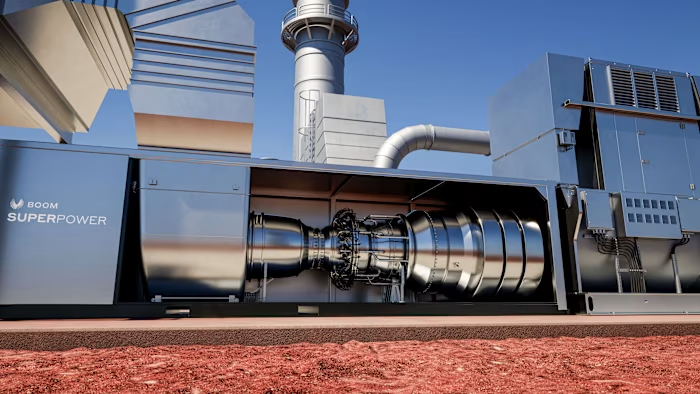
Data centres are increasingly turning to aircraft engines and fossil fuel generators to power AI operations due to delays in grid connection and supply chain issues, leading to a surge in demand for aeroderivative turbines and diesel generators, despite concerns over emissions and higher costs.
A $100 investment in Nvidia 10 years ago would now be worth over $23,000, thanks to a 22,980% return driven by its dominance in AI-related GPU markets, outperforming the S&P 500 significantly, with its revenue and net income soaring and becoming the world's most valuable company.
The AI boom is driving a surge in debt issuance by US utilities, with bond sales reaching a record $158 billion this year to fund infrastructure growth, potentially increasing investment risks despite the industry's regulated nature. Future investments are expected to rise, but concerns about an AI bubble and political risks could impact valuations and investor confidence.
Global investment in data centers reached a record $61 billion in 2025, driven by the AI boom and ongoing demand for infrastructure, with projections indicating rapid expansion over the next five years despite concerns over potential overspending and energy consumption.
Wharton’s Itay Goldstein discusses the potential for an AI bubble, the mechanics of market speculation, and the risks associated with the current AI boom, raising concerns about what might happen if the bubble bursts.
The risk of a US recession in 2026 has decreased, largely due to the AI boom and resilient economic indicators, though uncertainties remain across the labor market, inflation, consumer spending, and AI dependency. Experts suggest a high likelihood of avoiding a downturn this year, but warn that any significant negative shift in these areas could change the outlook.