
Inside-Out Exoplanet System Upends Formation Theory
TL;DR Summary
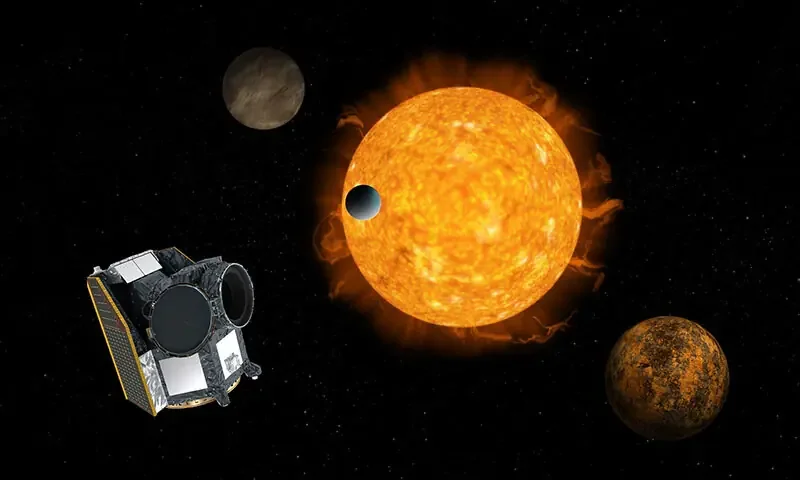
CHEOPS observations reveal four planets orbiting the red dwarf LHS 1903 far closer to their star than Mercury is to the Sun: two rocky super-Earths and two gaseous mini-Neptunes. The outermost planet, surprisingly rocky, challenges standard models that predict rocky worlds close in and gas giants farther out, suggesting an 'inside-out' assembly in which gas was depleted by inner planets or the atmosphere was stripped after formation. With a mass of about 5.8 Earth masses and a surface temperature around 60°C, it could be marginally habitable, and future JWST studies could probe its atmosphere.
- Astronomers puzzle over ‘inside out’ planetary system Dawn
- Astronomers detect a solar system they say should not be possible CNN
- This inside-out planetary system has astronomers scratching their heads Science News
- Weird inside-out planet system may have formed one world at a time New Scientist
- This Bizarre Star System Is Inside Out, and Astronomers Aren’t Sure How Gizmodo
Reading Insights
Total Reads
0
Unique Readers
10
Time Saved
3 min
vs 4 min read
Condensed
86%
677 → 94 words
Want the full story? Read the original article
Read on Dawn