
Webb Reveals Slow Black-Hole Starvation Quenching Pablo’s Galaxy
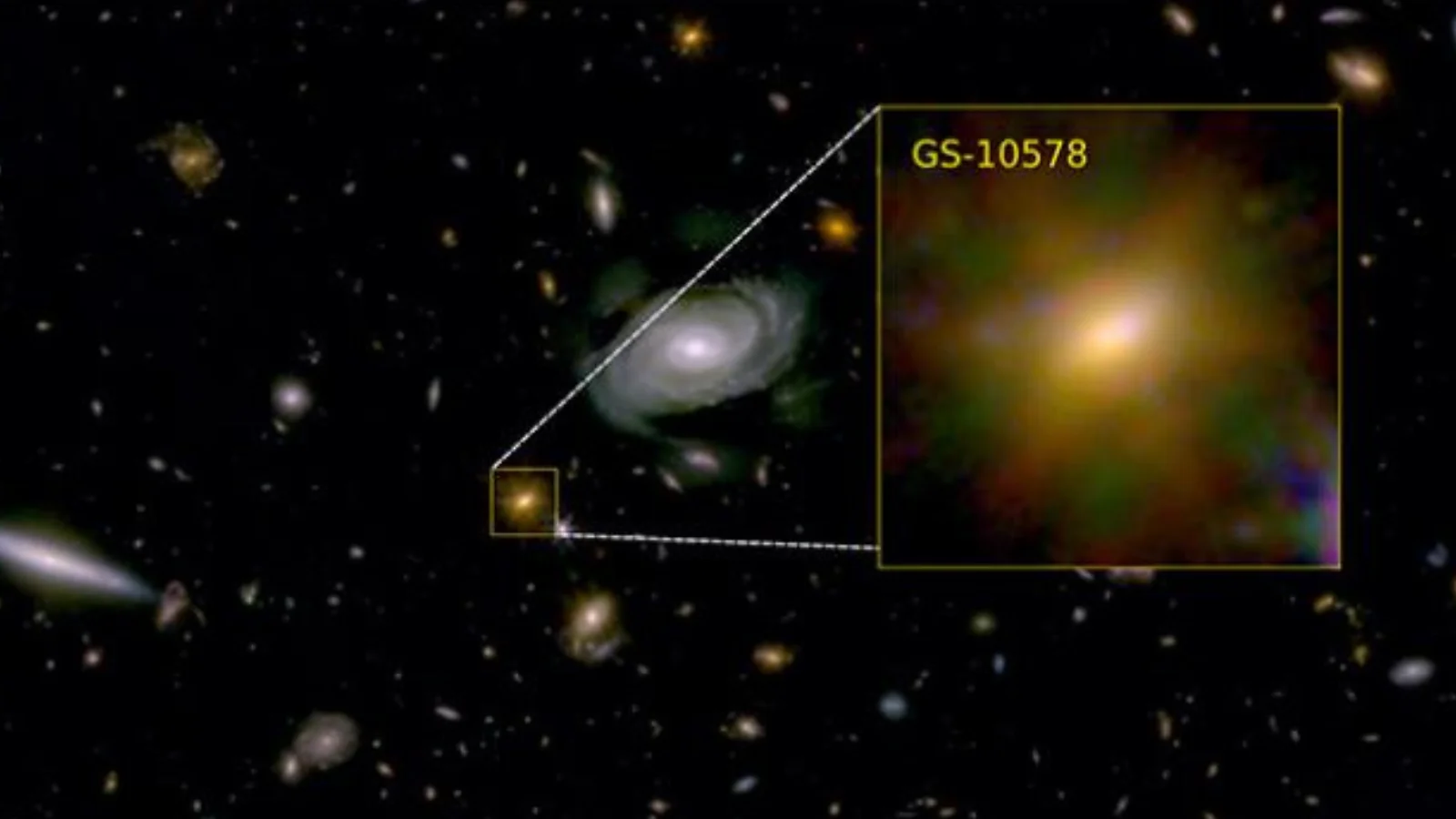
Astronomers using the James Webb Space Telescope and ALMA traced Pablo’s Galaxy (GS-10578) back to about 11 billion years ago and found it ceased forming stars not due to a violent merger but through slow starvation by its central supermassive black hole. Repeated gas outflows expelled star-forming gas and prevented fresh cold gas from refilling the reservoir, leaving the galaxy—seen as a calm rotating disc—without fuel for new stars and ending star formation around 400 million years ago. With an estimated gas-loss rate of ~60 solar masses per year, the remaining fuel could have run out in roughly 16–220 million years, suggesting black-hole feedback as a key quenching mechanism in early galaxies and potentially explaining why some young galaxies look mature in the early universe.
- 'Death by a thousand cuts': James Webb Space Telescope figures out how black hole murdered Pablo's Galaxy Space
- 'Death by a thousand cuts': Pablo's galaxy ran out of fuel as black hole choked off supplies Phys.org
- Measurement of the gas consumption history of a massive quiescent galaxy Nature
- JWST Just Discovered a Galaxy That Died 12 Billion Years Ago The Daily Galaxy
- This Young Galaxy Died Early — and Its Own Supermassive Black Hole May Be to Blame Green Matters
Reading Insights
0
4
75 min
vs 76 min read
99%
15,180 → 125 words
Want the full story? Read the original article
Read on Space