
Webb Reveals Dust Feeding Circinus Black Hole, Upending Core Emission Views
TL;DR Summary
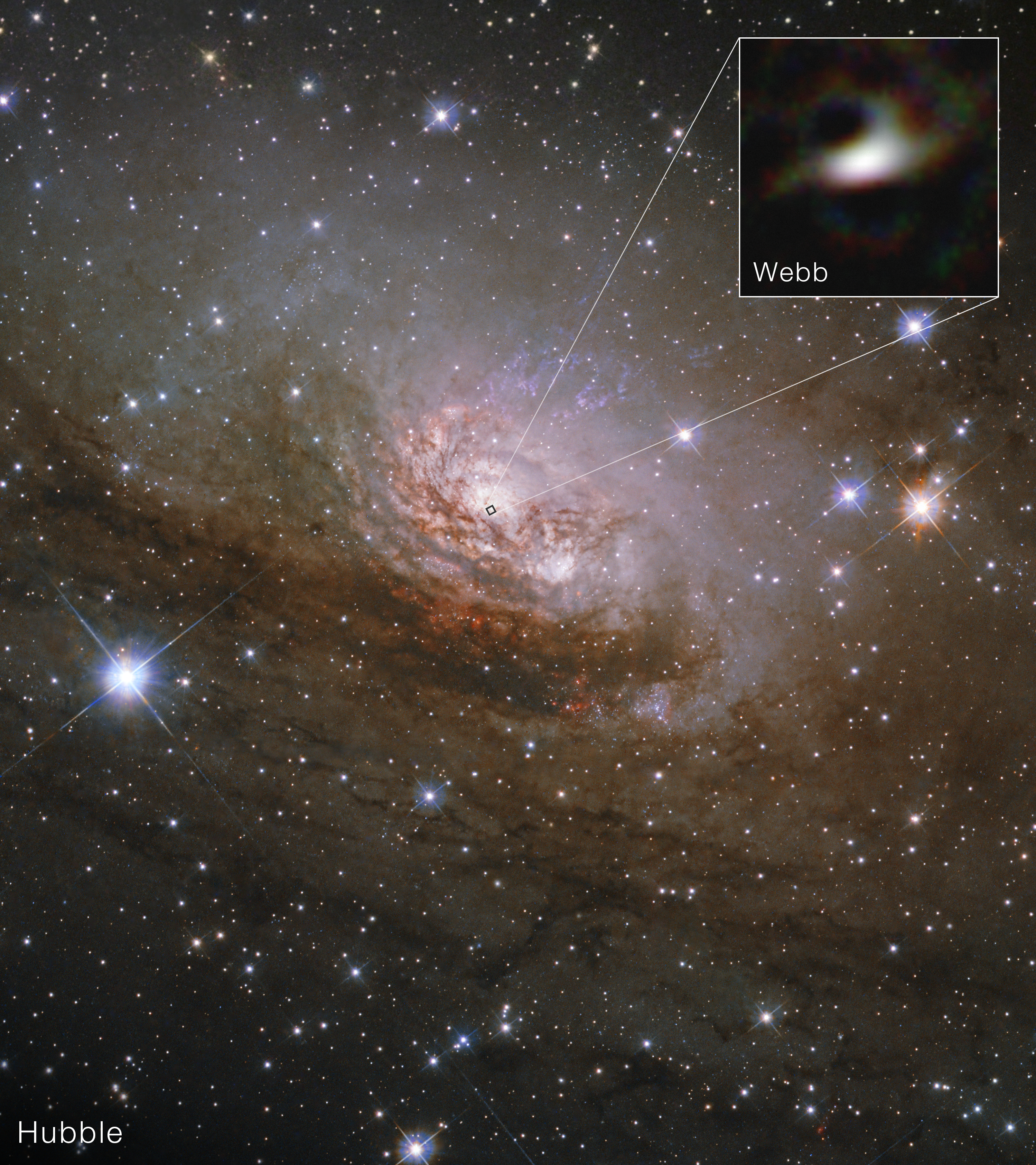
Webb’s Aperture Masking Interferometer on NIRISS allowed a high‑contrast look at Circinus’ core, yielding the sharpest view yet of a black hole’s surroundings. The study finds roughly 87% of the near‑infrared emission comes from hot dust near the black hole’s torus rather than from outflows, overturning decades of models that emphasized outflows. This marks the first extragalactic infrared interferometry in space and demonstrates Webb’s ability to double effective resolution in a focused region, offering a technique to study other bright black holes and build a broader picture of accretion versus outflow contributions.
Topics:science#black-holes#circinus-galaxy#infrared-astronomy#interferometry#james-webb-space-telescope#space
- NASA’s Webb Delivers Unprecedented Look Into Heart of Circinus Galaxy NASA Science (.gov)
- Webb Space Telescope’s Special Aperture Turns One Sensor Into Seven PetaPixel
- JWST interferometric imaging reveals the dusty torus obscuring the supermassive black hole of Circinus galaxy Nature
- Circinus Galaxy (Hubble and Webb) European Space Agency
- NASA's James Webb Space Telescope data show hot dust near the black hole dominates Circinus emissions primetimer.com
Reading Insights
Total Reads
0
Unique Readers
6
Time Saved
7 min
vs 8 min read
Condensed
94%
1,490 → 92 words
Want the full story? Read the original article
Read on NASA Science (.gov)