
Cosmic dawn mapped in 3D reveals a sea of light across the early universe
TL;DR Summary
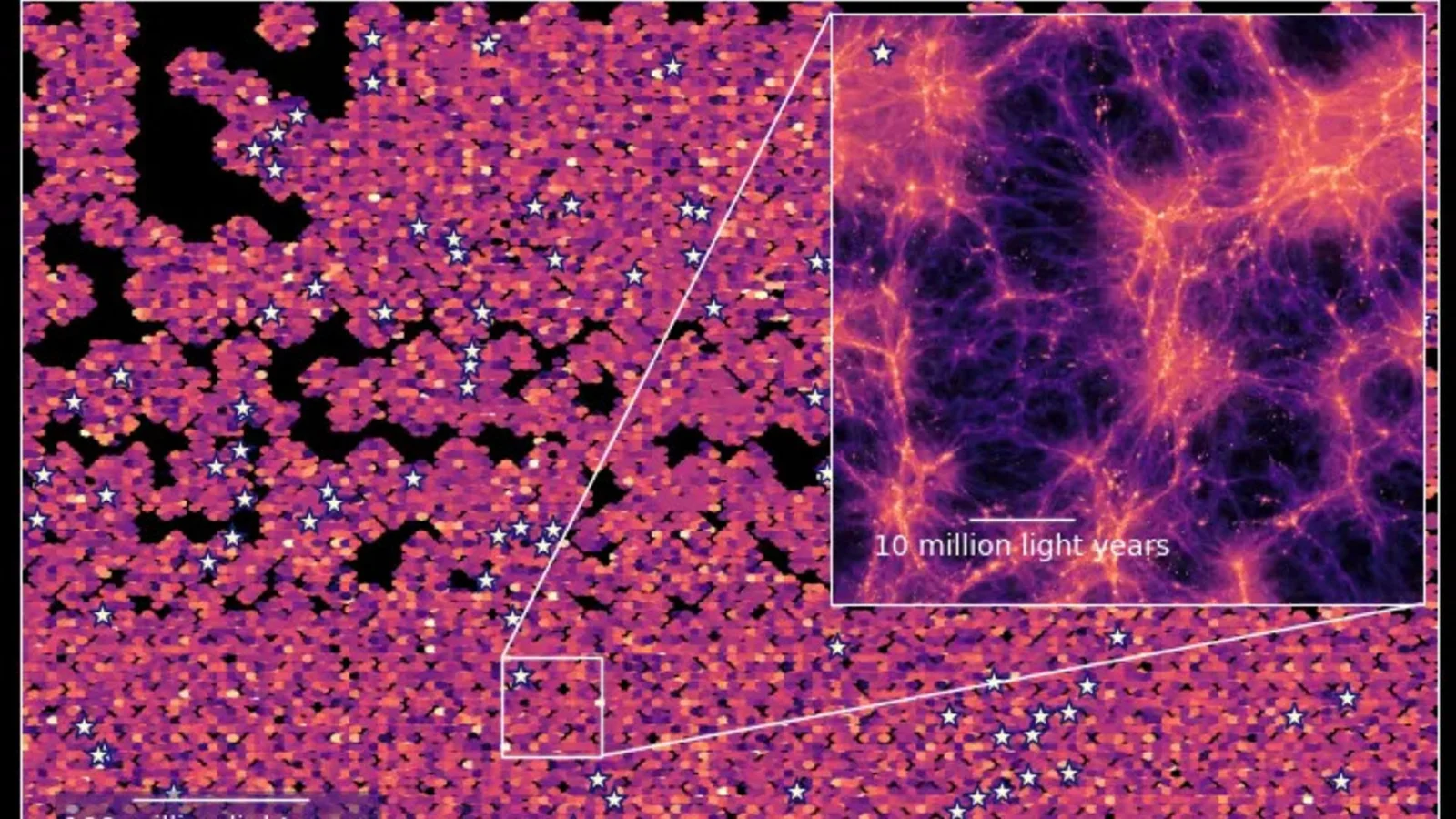
Astronomers used line-intensity mapping from the Hobby-Eberly Telescope Dark Energy Experiment (HETDEX) to create a 3D map of the early universe, revealing a vast ‘sea of light’ from hydrogen Lyman-alpha emission that traces galaxy and gas distributions 9–11 billion years ago. The work helps probe gravity and dark energy’s role in cosmic evolution, leveraging hundreds of millions of spectra; further noise-reduction advances will enable mapping even fainter structures and tighten cosmological constraints.
- Enormous 3D map of the universe shows brilliant 'sea of light' near the cosmic dawn Live Science
- Astronomers unveil largest 3D universe map of its kind, illuminating 'hidden' cosmic structures Space
- HETDEX data reveal a vast 'sea of light' between early galaxies Phys.org
- S&T physicist’s research helps reveal previously unseen galaxies Missouri S&T
- Astronomers Find Hidden Structures in Early Universe Sci.News
Reading Insights
Total Reads
0
Unique Readers
0
Time Saved
68 min
vs 69 min read
Condensed
99%
13,758 → 72 words
Want the full story? Read the original article
Read on Live Science