
Unveiling the Universe's Secrets with the James Webb Space Telescope
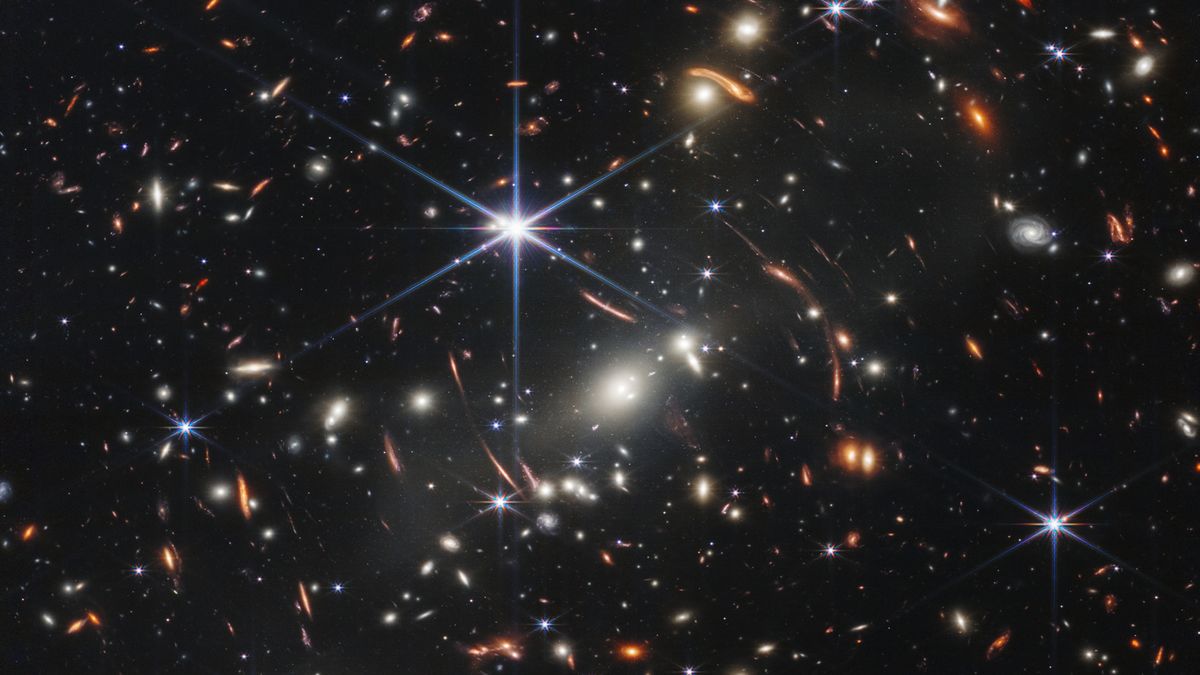
The James Webb Space Telescope (JWST) and other powerful instruments have spotted some of the earliest and most distant galaxies ever seen. But how do scientists know that they are so old? The link between time and distance in space comes from the fact that light doesn't travel instantaneously. Instead, light in a vacuum travels at a set speed of around 3.0 x10⁸ meters per second. The expansion of the universe is causing galaxies to recede away from each other, with more distant objects moving away more rapidly. This results in the wavelength of light being "stretched" out toward the longer, redder, frequencies of the electromagnetic spectrum. This is a phenomenon called "redshift." Spectroscopy takes advantage of the fact that different chemical elements emit and absorb light at a specific wavelength. That means light from distant galaxies and stars carries the "fingerprint" of the elements they are composed of.
- How do we know how far away and early in the universe galaxies are? Space.com
- Compact galaxy's discovery shows Webb telescope's 'amazing' power Yahoo News
- James Webb Space Telescope could be finding galaxies that shouldn’t make sense The Indian Express
- James Webb Space Telescope finds tiny early galaxy packing big star-forming punch Space.com
- James Webb Space Telescope's view of the universe - Skywatching Castanet.net
Reading Insights
0
0
8 min
vs 9 min read
91%
1,703 → 149 words
Want the full story? Read the original article
Read on Space.com