
"Revealing the Flat Truth: Jupiter's Surprising Past and Baby Exoplanets' Shape"
TL;DR Summary
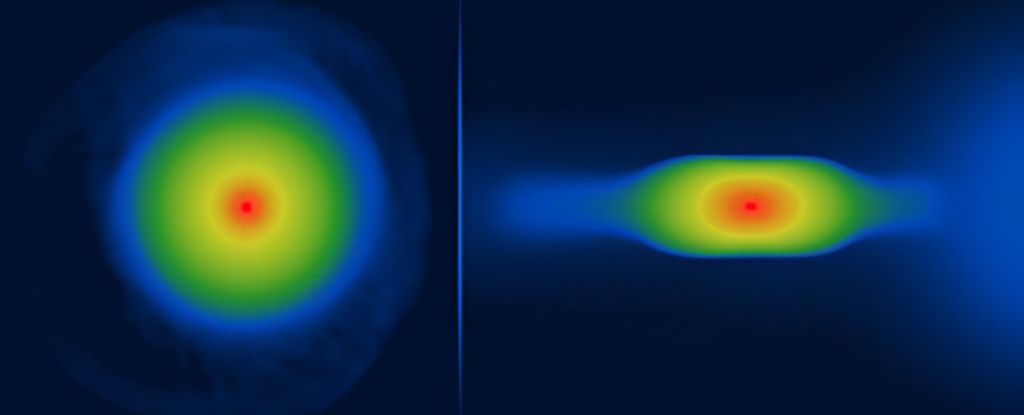
New simulations suggest that gas giant protoplanets may initially form as flattened oblate spheroids before settling into their familiar round shape, shedding light on the diverse ways planets can grow in the turbulent disks of dust and gas around young stars. This finding challenges the assumption that planets form as perfect spheres and provides insight into the process of disk instability planet formation. The research, conducted by astrophysicists at the University of Central Lancashire, has been accepted into Astronomy & Astrophysics Letters and offers valuable implications for understanding and interpreting developing planets in stellar disks.
Topics:science#astrophysics#gas-giants#planet-formation#protoplanets#science-and-astronomy#simulation
- Earth Isn't Flat, But New Theory Suggests Jupiter Might Once Have Been ScienceAlert
- Jupiter may have been flat at one point, not spherical The Independent
- Surprise! Baby exoplanets might look like Smarties candies rather than spheres Space.com
- New research finds that young planets are flattened structures rather than spherical Phys.org
- Newborn gas planets may be surprisingly flat – new research The Conversation Indonesia
Reading Insights
Total Reads
0
Unique Readers
12
Time Saved
3 min
vs 4 min read
Condensed
86%
684 → 95 words
Want the full story? Read the original article
Read on ScienceAlert