
"James Webb Telescope Discovers Crucial Carbon Compounds for Life in Distant Star System"
TL;DR Summary
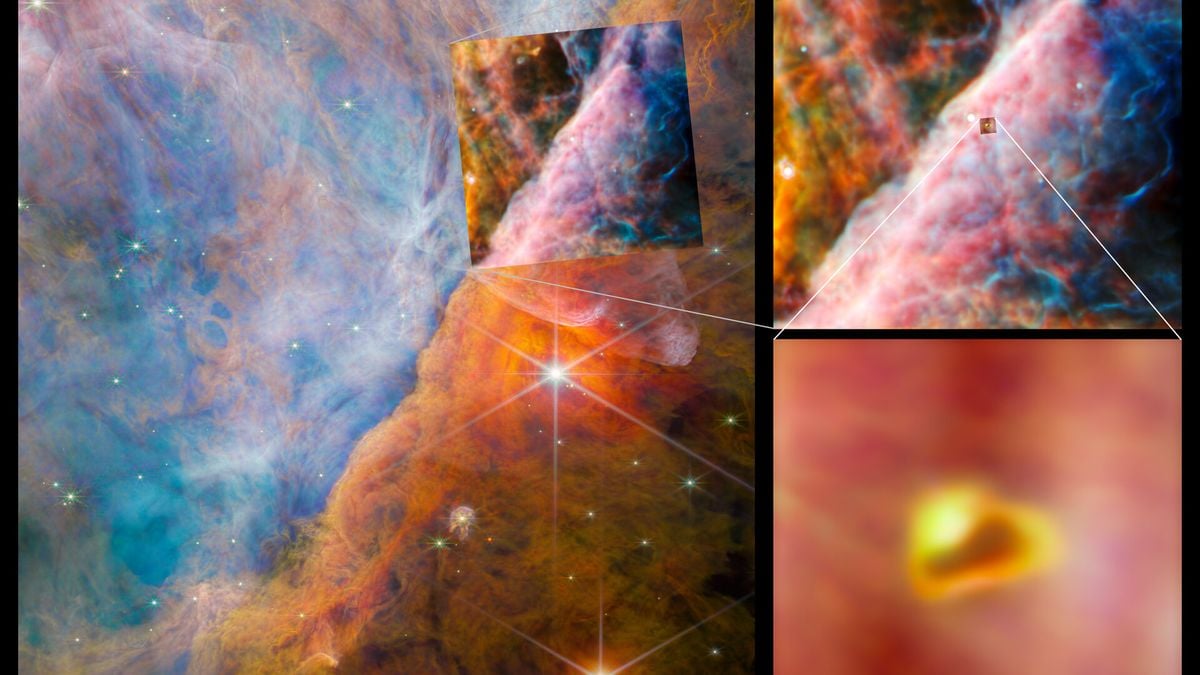
The James Webb Space Telescope (JWST) has detected a carbon molecule called methyl cation (CH3+) in a planet-forming disk around a young star in the Orion Nebula. This discovery is significant because it challenges the belief that intense ultraviolet radiation destroys complex organic molecules needed for life. Methyl cation is a key molecule in interstellar chemistry and can kick-start the growth of more complex carbon molecules. The detection of this molecule validates the sensitivity of JWST and provides insights into the early stages of life's origins.
Topics:science#carbon-molecule#interstellar-chemistry#james-webb-space-telescope#planet-forming-disk#science-and-astronomy#ultraviolet-radiation
- James Webb Space Telescope spots carbon molecule in planet-forming disk Space.com
- New NASA Images Reveal Life In Another Galaxy Giant Freakin Robot
- Webb Image Uncovers Carbon Molecule in Distant Star System Gizmodo
- JWST spots a molecule vital to life in nearby protoplanetary disk | Astronomy.com Astronomy Magazine
- James Webb telescope discovers carbon compounds crucial to life in star system 1000 light-years from Earth Livescience.com
Reading Insights
Total Reads
0
Unique Readers
9
Time Saved
3 min
vs 4 min read
Condensed
89%
759 → 86 words
Want the full story? Read the original article
Read on Space.com