
"Unveiling the Cosmic Origins of Dust Formation in Supernovae"
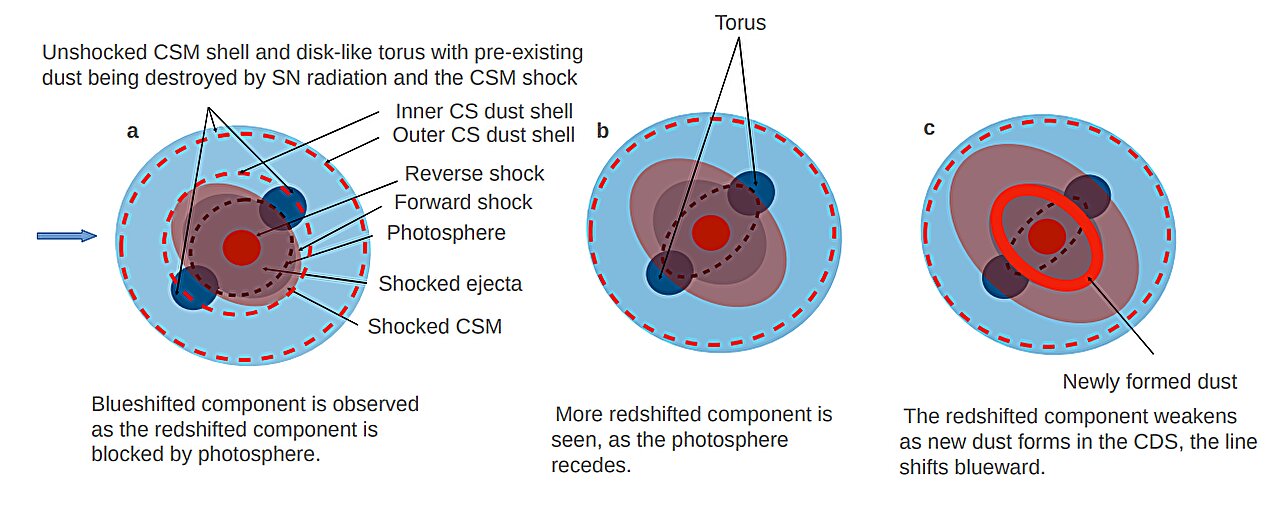
An international team of astronomers has discovered a previously unknown source of cosmic dust in the universe: Type 1a supernovae interacting with gas from their surroundings. This finding, published in Nature Astronomy, suggests that thermonuclear supernovae may account for a significant amount of dust in elliptical galaxies. The researchers monitored a supernova, SN 2018evt, for over three years and observed the creation of dust in the circumstellar gas after it cooled following the supernova shock wave passing through it. This discovery sheds light on the contribution of thermonuclear supernovae to cosmic dust and may have implications for space exploration, particularly with the upcoming James Webb Space Telescope.
- Researchers discover cosmic dust storms from Type 1a supernova Phys.org
- Cosmic dust from 'zombie' galaxies could form planets and life The Telegraph
- Newly formed dust within the circumstellar environment of SN Ia-CSM 2018evt Nature.com
- Dust Formation in Supernovae: Implications and Findings Medriva
- Cosmic dust storms: Supernova sparks new understanding Open Access Government
Reading Insights
0
10
3 min
vs 4 min read
85%
699 → 107 words
Want the full story? Read the original article
Read on Phys.org