
Uncovering Supernova Secrets from the Early Universe's Massive Stars.
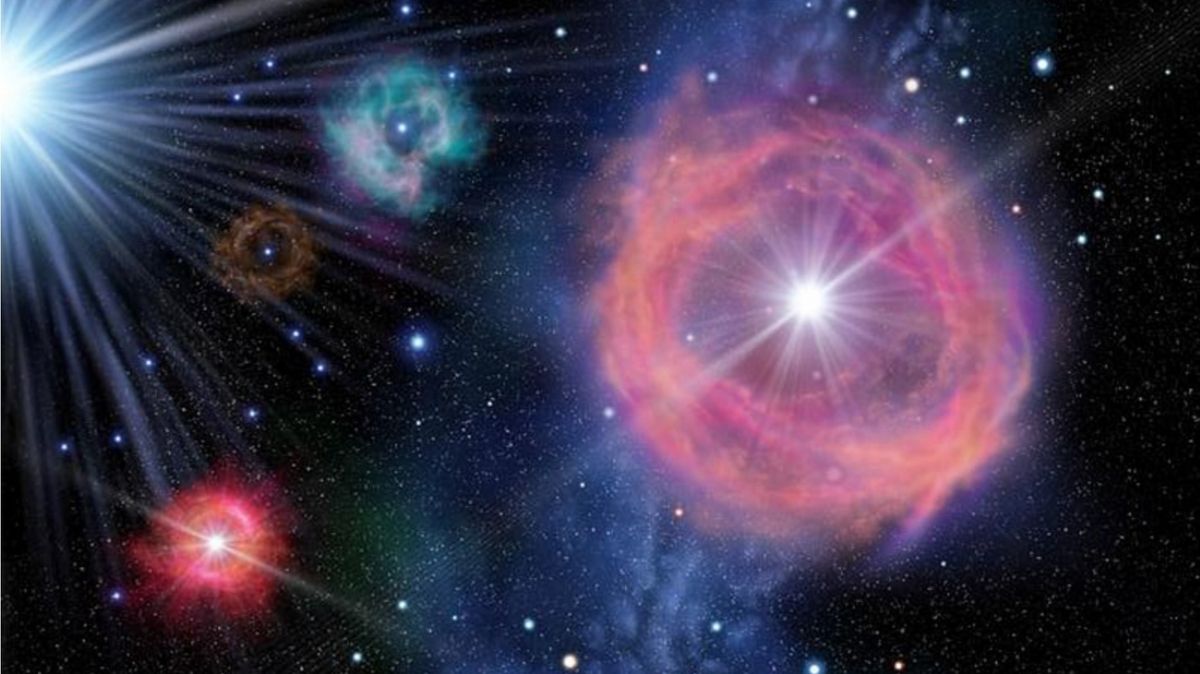
The chemical composition of a strange star found in the halo of our Milky Way galaxy represents the first evidence of the violent deaths of the universe's first stars, a new study reports. These unique explosions are referred to as pair-instability supernovae (PISNe). The chemically peculiar star LAMOST J1010+2358 could represent the first evidence of PISNe from early massive stars. The researchers used data collected by the Large Sky Area Multi-Object Fiber Spectroscopic Telescope (LAMOST) survey and follow-up observations by the Subaru Telescope in Hawaii to determine that LAMOST J1010+2358 formed in a gas cloud that was dominated by the remains of a 260-solar-mass star that died in a PISNe blast.
- Strange star holds 'holy grail' clues about unique supernova explosions in the early universe Space.com
- Researchers discover chemical evidence for pair-instability supernova from a very massive first star Phys.org
- A metal-poor star with abundances from a pair-instability supernova Nature.com
- Stellar Archaeology: Chemical Clues Reveal Supernova Secrets From Universe's First Massive Stars SciTechDaily
Reading Insights
0
1
2 min
vs 3 min read
81%
594 → 111 words
Want the full story? Read the original article
Read on Space.com