
James Webb Telescope uncovers secrets of ancient galaxies and celestial monsters.
TL;DR Summary
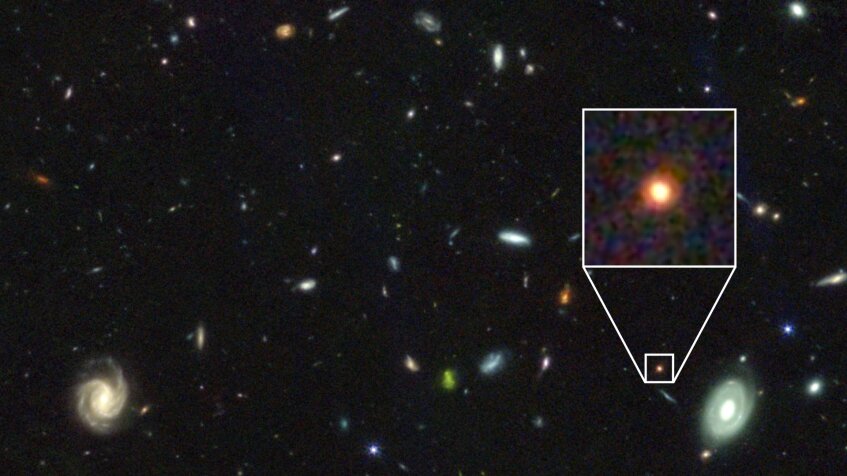
The James Webb Space Telescope has identified a massive, densely packed galaxy known as GS-9209, which formed just 600 to 800 million years after the Big Bang and is the earliest of its kind found to date. Despite being around 10 times smaller than the Milky Way, GS-9209 has a similar number of stars to our own galaxy. GS-9209 is the earliest known example of a galaxy no longer forming stars, known as a quiescent galaxy, and contains a supermassive black hole at its center that is five times larger than astronomers might anticipate in a galaxy with this number of stars.
Topics:science#astronomy#gs-9209#james-webb-space-telescope#quiescent-galaxy#star-formation#supermassive-black-hole
- Ancient galaxy's traits revealed using Webb telescope Phys.org
- Ancient distant galaxy GS-9209 thought to have supermassive black hole in centre Sky News
- What the Webb Telescope's 'Universe breaker' galaxies can tell us about the early cosmos BBC Sky at Night Magazine
- James Webb Telescope Finds Evidence Of ''Celestial Monster'' Stars The Size of 10,000 Suns NDTV
- James Webb Space Telescope finds footprints of celestial monsters Geo News
Reading Insights
Total Reads
0
Unique Readers
8
Time Saved
2 min
vs 3 min read
Condensed
81%
527 → 102 words
Want the full story? Read the original article
Read on Phys.org