
Birth of Distant Galaxy Cluster Challenges Early Universe Theories
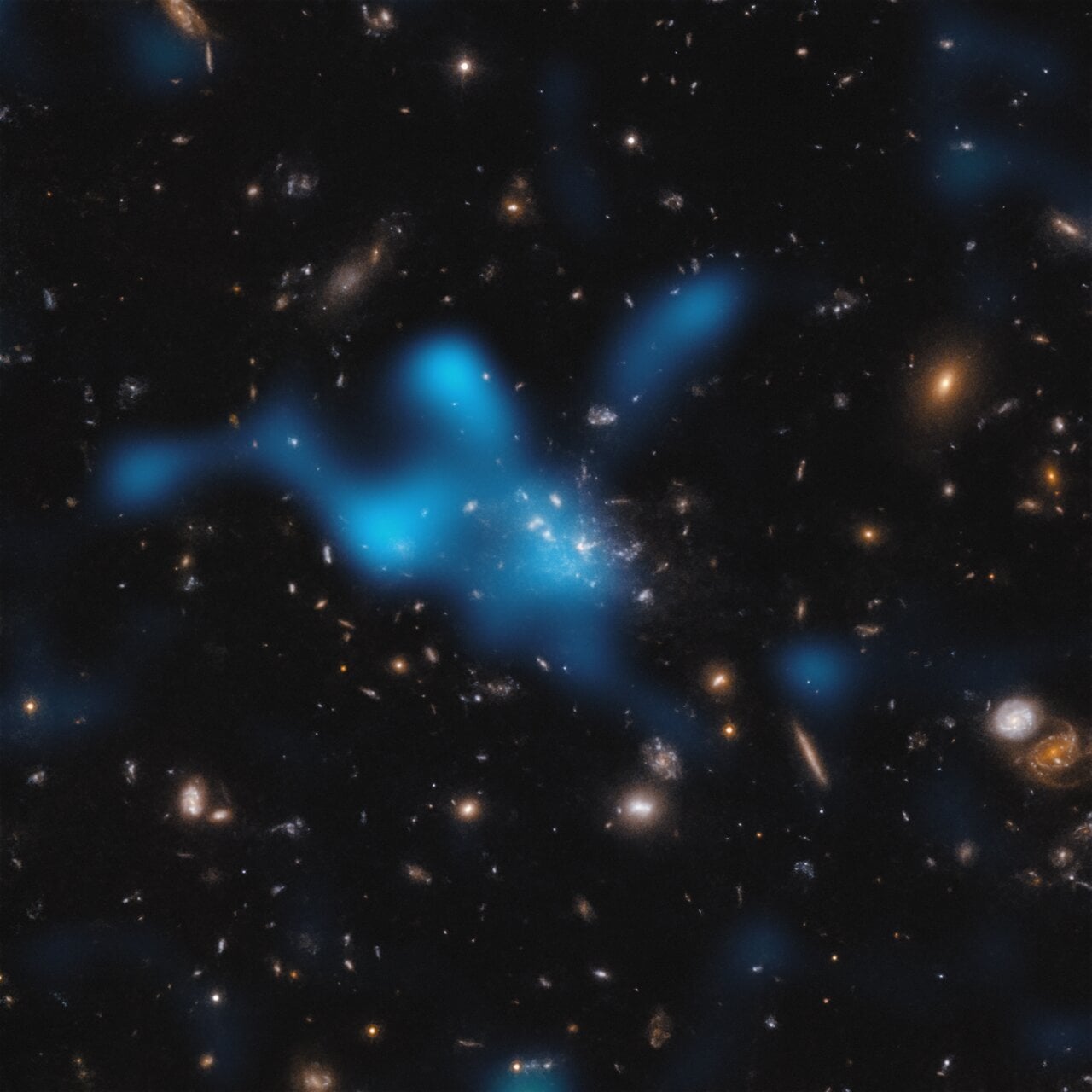
Astronomers using the Atacama Large Millimeter/submillimeter Array (ALMA) have detected a large reservoir of hot gas in the still-forming galaxy cluster around the Spiderweb galaxy, the most distant detection of such hot gas yet. The discovery indicates that the system is on its way to becoming a proper, long-lasting galaxy cluster rather than dispersing. The team detected the intracluster medium (ICM) of the Spiderweb protocluster through the thermal Sunyaev-Zeldovich (SZ) effect, which happens when light from the cosmic microwave background passes through the ICM. The Spiderweb protocluster contains a vast reservoir of hot gas at a temperature of a few tens of millions of degrees Celsius, outweighing the cold gas previously detected by thousands of times.
- Astronomers witness the birth of a very distant cluster of galaxies from the early universe Phys.org
- Galaxy cluster spied forming in early universe (photos, video) Space.com
- Forming intracluster gas in a galaxy protocluster at a redshift of 2.16 Nature.com
- Astronomers Use the Last Light of the Big Bang to Solve a Galactic Mystery Inverse
- Earliest galaxies challenge ideas about star birth in infant universe Science
Reading Insights
0
7
4 min
vs 5 min read
88%
1,000 → 116 words
Want the full story? Read the original article
Read on Phys.org