
Scientists at University College Cork (UCC) have made a breakthrough in quantum computing by discovering a spatially modulating superconducting state in a new superconductor material called uranium ditelluride (UTe2). This new superconductor could potentially solve one of the biggest challenges in quantum computing. UTe2 is believed to be a relevant topological superconductor, which could lead to more stable and useful quantum computers. The discovery has significant implications for the future of quantum computing and has attracted the attention of Microsoft, which has already invested billions of dollars into topological quantum computing.
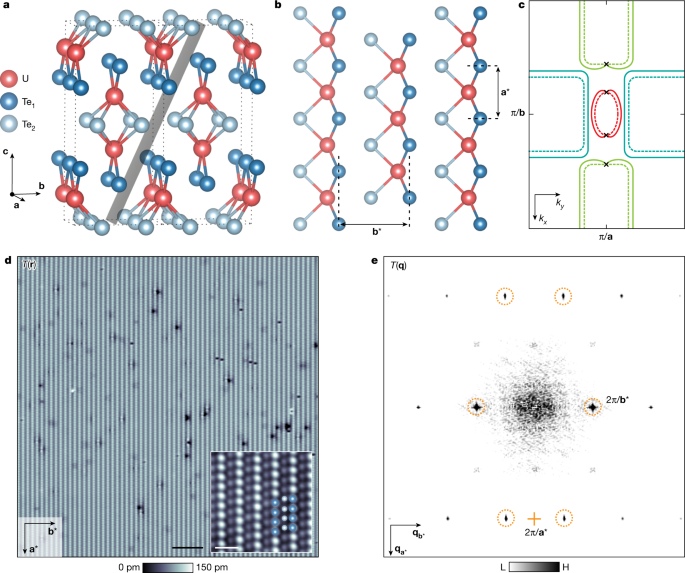
Researchers have detected a pair density wave (PDW) state in the compound UTe2, a superconductor with spin-triplet pairing. The PDW state is characterized by a spatially modulating superconductive order parameter. Visualization techniques using scanning tunneling microscopy revealed the coexistence of a charge density wave (CDW) and PDW states in UTe2. The CDW exhibits incommensurate charge-density modulations at three wavevectors, while the PDW is induced at the wavevector of the CDW. These findings provide further evidence for the presence of a spin-triplet, odd-parity, nodal, time-reversal symmetry breaking, chiral superconductor in UTe2.
Scientists at the Macroscopic Quantum Matter Group laboratory in University College Cork have discovered a spatially modulating superconducting state in a new superconductor called uranium ditelluride (UTe2). This discovery could have significant implications for the future of quantum computing. UTe2 shows properties of a topological superconductor, which could be used as a basis for more stable and useful quantum computers. The understanding of UTe2's fundamental superconducting properties brings us closer to practical quantum computers.