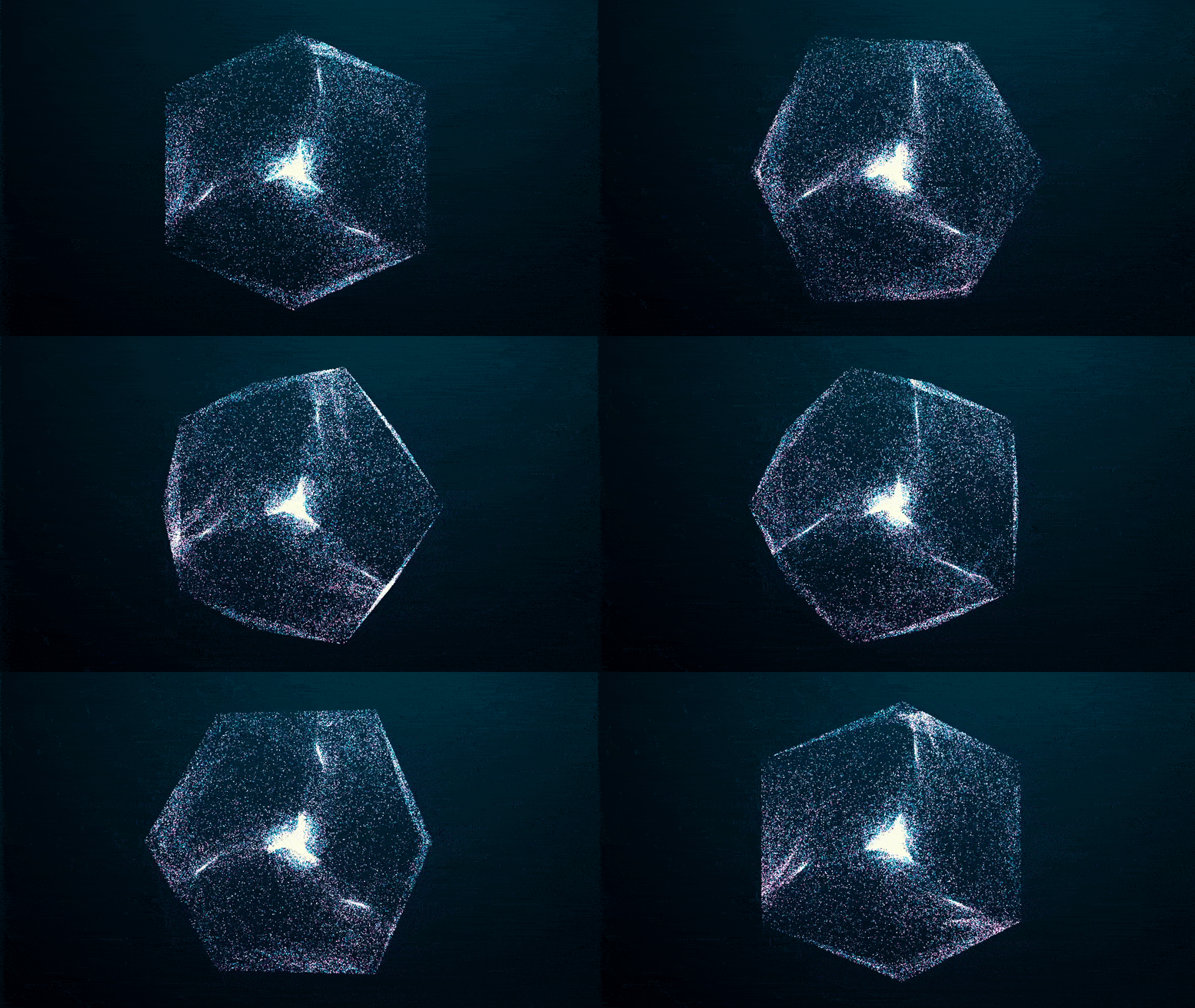
Physicists at TU Dortmund University have successfully extended the lifespan of a time crystal, confirming a theoretical concept proposed by Nobel laureate Frank Wilczek. The time crystal, made of indium gallium arsenide, demonstrated periodic behavior in a system without periodic external influence, living millions of times longer than previously achieved. This breakthrough in quantum physics marks a significant advancement and opens up possibilities for further research and analysis of chaotic behavior in such systems.

Researchers from TU Dortmund University have created a semiconductor from indium gallium arsenide that exhibits continuous time crystal behavior, setting a new record for sustained oscillations lasting at least 40 minutes. This breakthrough in quantum physics opens the door to new possibilities in precise frequency measurement and could lead to the development of new kinds of hardware.
Scientists at TU Dortmund University have successfully created an ultra-robust time crystal within a semiconductor material, demonstrating its ability to maintain periodic oscillations for roughly 40 minutes, a significant improvement over previous attempts. This breakthrough has potential applications in quantum computing, where time crystals could stabilize qubits, and in timekeeping devices, where their intrinsic temporal regularity could enhance precision. The development of a stable time crystal in a semiconductor system opens the door to further experimental investigation and real-world applications, while also challenging conventional understanding of non-equilibrium thermodynamics.
Physicists from TU Dortmund University have achieved a new record in time crystal research by creating one that lasted at least 40 minutes, which is 10 million times longer than the previous record. Time crystals are unique in that they exhibit rhythmic changes in physical properties without external influence, defying the laws of thermodynamics and remaining in perpetual motion.
Physicists from TU Dortmund University have successfully created a highly durable time crystal, a phenomenon postulated by Nobel laureate Frank Wilczek around ten years ago. This time crystal, made of indium gallium arsenide, demonstrated a periodic behavior in time, with a lifetime of at least 40 minutes, which is 10 million times longer than previously demonstrated. The crystal's nuclear spin polarization spontaneously generates oscillations, equivalent to a time crystal, and can potentially live even longer. This breakthrough opens up possibilities for studying chaotic behavior in such systems and has been published in Nature Physics.