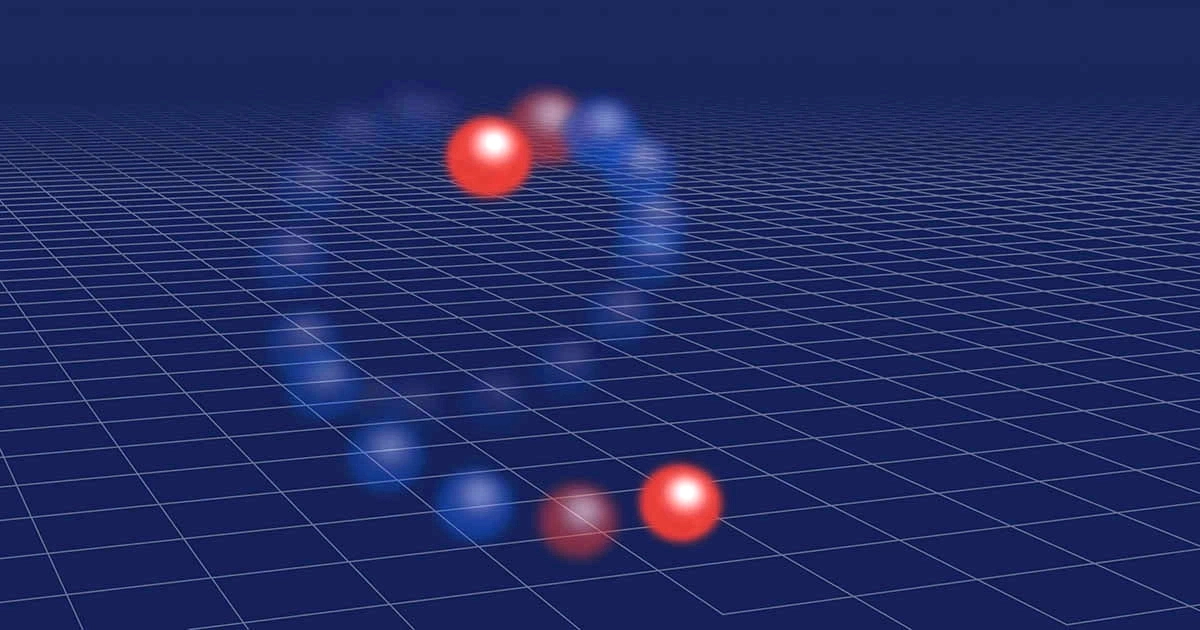
Mathematicians have revived a class of overlooked particles called neglectons, which, when combined with Ising anyons, could overcome their limitations and enable universal quantum computation through braiding, potentially advancing the development of more stable and powerful quantum computers.
Scientists at University College Cork have discovered a spatially modulating superconducting state in Uranium Ditelluride (UTe2), a new and unusual superconductor. This breakthrough could have significant implications for quantum computing, offering a potential solution to one of its major challenges. UTe2 shows promise as a topological superconductor, which could lead to more stable and efficient quantum computers. The discovery of this unique superconducting state in UTe2 contributes to the understanding of its fundamental properties and brings us closer to practical quantum computing applications.
Scientists at University College Cork (UCC) have made a breakthrough in quantum computing by discovering a spatially modulating superconducting state in a new superconductor material called uranium ditelluride (UTe2). This new superconductor could potentially solve one of the biggest challenges in quantum computing. UTe2 is believed to be a relevant topological superconductor, which could lead to more stable and useful quantum computers. The discovery has significant implications for the future of quantum computing and has attracted the attention of Microsoft, which has already invested billions of dollars into topological quantum computing.
Scientists at the Macroscopic Quantum Matter Group laboratory in University College Cork have discovered a spatially modulating superconducting state in a new superconductor called uranium ditelluride (UTe2). This discovery could have significant implications for the future of quantum computing. UTe2 shows properties of a topological superconductor, which could be used as a basis for more stable and useful quantum computers. The understanding of UTe2's fundamental superconducting properties brings us closer to practical quantum computers.
Physicists are using quantum processors to create non-abelian anyons, elusive particles that could serve as the foundation for topological quantum computing. These particles have shared memory that can be manipulated by braiding, making them ideal qubits. Quantum processors are also being used to simulate and correct errors in shoddy qubits, extending the lifespan of anyons. Theorists are also working on creating a more complicated phase of quantum matter where true non-abelian anyons arise natively in a pristine phase of matter.