
Tag

Sustainable Technologies

All articles tagged with #sustainable technologies

"Miassite: Nature's First Unconventional Superconductor"
science-and-technology1 year ago

"Miassite: Nature's First Unconventional Superconductor"

Scientists at Ames National Laboratory have identified "miassite," a naturally occurring mineral with an unconventional chemical composition, as the first natural superconductor found in the Earth's crust. This discovery, detailed in a study published in Communication Materials, could pave the way for future developments in sustainable and cost-effective technologies.

Unraveling the Enigma: Unveiling the Puzzling Behavior of Cuprates and its Superconductor Implications
science-and-technology2 years ago

Unraveling the Enigma: Unveiling the Puzzling Behavior of Cuprates and its Superconductor Implications

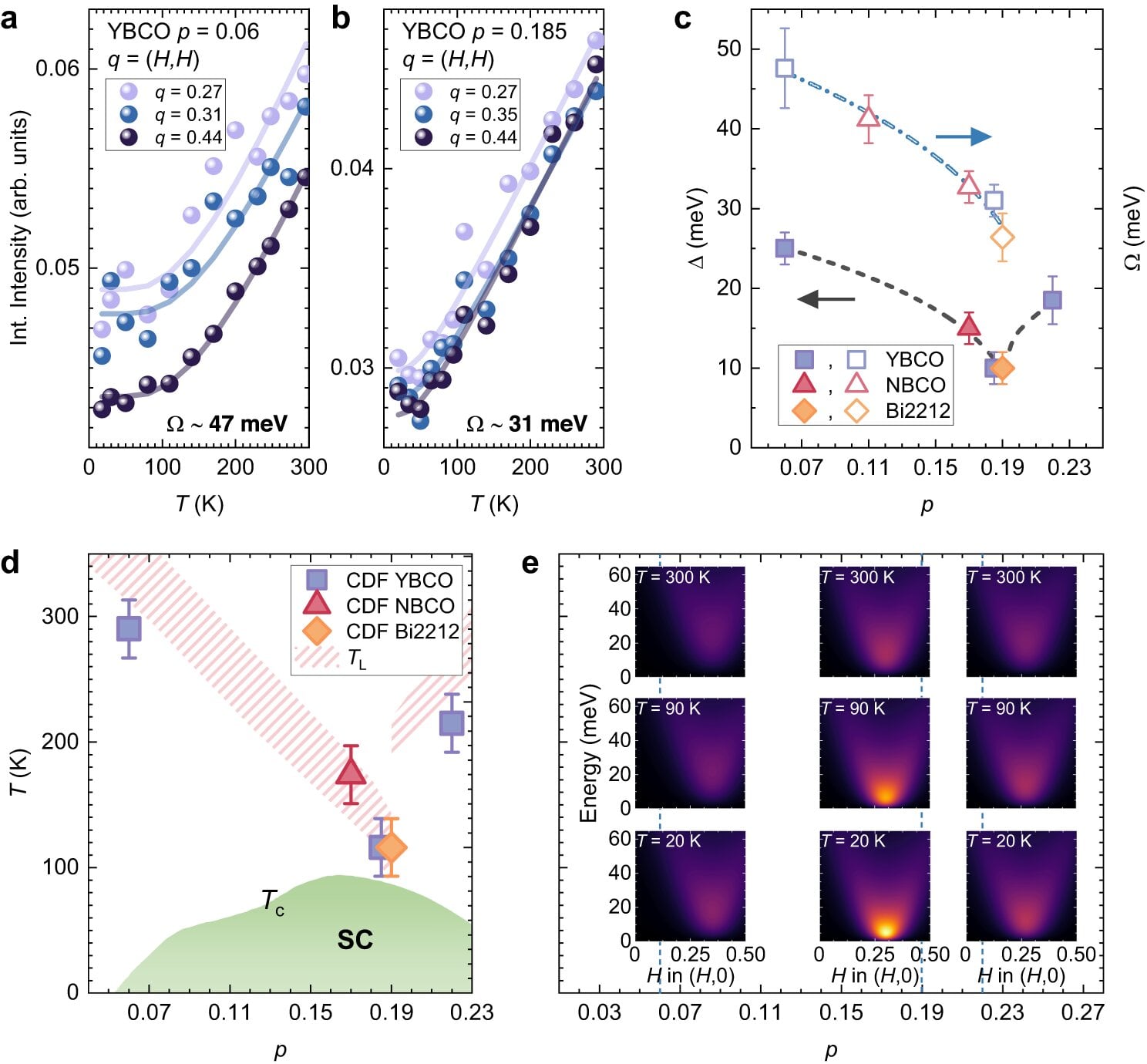
Researchers have discovered a quantum critical point connected to the "strange metal" phase of high-critical-temperature copper-based superconductors. The study, based on X-ray scattering experiments, reveals the existence of charge density fluctuations that make cuprates behave like "strange" metals. This discovery could lead to the development of better materials with higher critical temperatures, advancing superconductivity research and contributing to sustainable technologies.

Coal Mines Uncover Rare Earth Treasures, Revolutionizing Energy Transition
energy-transition2 years ago

Coal Mines Uncover Rare Earth Treasures, Revolutionizing Energy Transition

The discovery of rare earth elements (REE) in coal mines, such as the recent find in Wyoming, could potentially give coal a role in the energy transition. While coal is widely criticized for its environmental impact, the presence of REEs in coal mines offers an opportunity for more sustainable use. REEs are predominantly found in hard rock deposits, making them difficult and expensive to mine and process. However, the unconventional REE deposits in coal mines can be extracted using normal surface mining techniques and processed in a more economic and environmentally friendly manner. These discoveries could be strategically significant as countries seek to reduce their dependence on China, which currently dominates the supply and refining of rare earths.

"Algorithmic Breakthrough Paves Way for Sustainable Technologies with Atomic Blueprint"
science-and-technology2 years ago

"Algorithmic Breakthrough Paves Way for Sustainable Technologies with Atomic Blueprint"

Researchers at the University of Liverpool have developed a mathematical algorithm that can predict the structure of any material based solely on knowledge of its constituent atoms. The algorithm evaluates entire sets of possible structures simultaneously, accelerating the identification of the correct solution. This breakthrough has the potential to revolutionize the design of new materials for sustainable technologies, such as batteries, solar absorbers, and catalysts. The algorithm was demonstrated on quantum computers, further enhancing its computational capabilities. The ability to predict crystal structures with certainty opens up opportunities to synthesize materials using widely available elements and replace those based on scarce or toxic elements, ultimately meeting the challenges of a sustainable society.

Algorithmic Breakthrough Paves Way for Sustainable Materials in Technology
science-and-technology2 years ago

Algorithmic Breakthrough Paves Way for Sustainable Materials in Technology

Researchers at the University of Liverpool have developed a mathematical algorithm that can predict the structure of any material based on knowledge of its constituent atoms. The algorithm evaluates entire sets of possible structures simultaneously, accelerating the identification of the correct solution. This breakthrough has the potential to revolutionize the design of new materials for sustainable technologies, such as batteries, solar absorbers, and catalysts. The algorithm was demonstrated on quantum computers, further enhancing its computational power. This advancement offers the ability to define the platform for future technologies and create materials that replace those based on scarce or toxic elements, meeting the challenges of a sustainable society.