Stability AI largely won a court case against Getty Images in the UK, with the court ruling that while Getty's trademark claim succeeded in part, its copyright infringement claim was dismissed, marking a significant legal victory for AI companies amid ongoing disputes over intellectual property rights in AI training.

Universal Music Group and Stability AI have announced a strategic partnership to develop professional AI music creation tools that prioritize artist feedback and responsible training, aiming to support creative processes while ensuring licensing and copyright safety.
EA's recent use of AI tools has reportedly caused more issues than benefits for developers, including hallucinations in AI-generated code and concerns over art training data devaluing artists' work, despite the company's push to integrate AI more deeply, including a partnership with Stability AI and industry-wide shifts towards AI automation.
Electronic Arts has partnered with Stability AI to develop AI-powered tools for creating game assets and environments, aiming to accelerate development and reduce costs amid financial challenges, while also enhancing creative expression.
EA is partnering with Stability AI to develop AI tools that enhance game creation processes, aiming to support artists and developers in creating more immersive content while maintaining human creativity at the core. The collaboration will focus on developing AI models for faster content generation and visualization, with AI serving as a supportive tool rather than a replacement. EA's CEO emphasizes AI's role in evolving their workflows, and the company is exploring further AI integration to boost profits and innovation in gaming.
Electronic Arts has partnered with Stability AI to develop AI-powered tools that enhance creativity and streamline content creation for artists, designers, and developers, aiming to accelerate game development and enable more immersive experiences.
Stability AI and Electronic Arts have partnered to develop advanced generative AI tools that enhance game development by enabling faster iteration, improved workflows, and expanded creative possibilities for artists, designers, and developers.
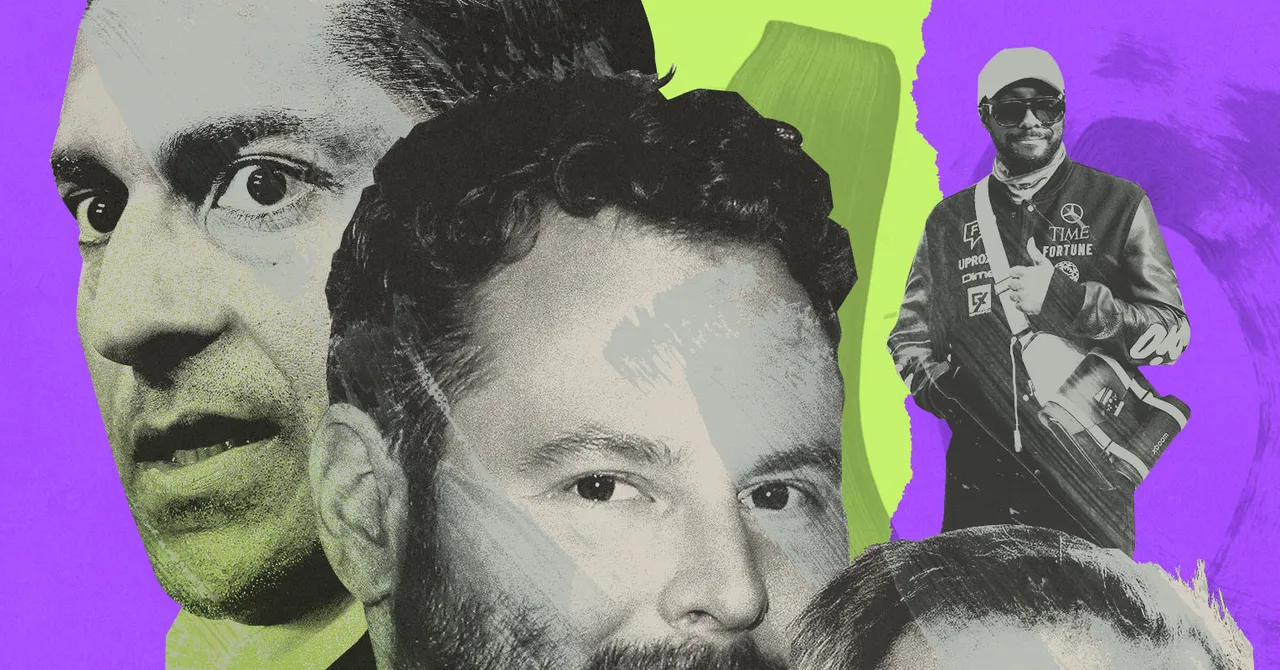
The article discusses how AI has already significantly impacted Hollywood and the entertainment industry, highlighting the rise of generative AI and the competitive struggles of companies like Stability AI, which is aiming to outpace rivals in this rapidly evolving field.
Stability AI has launched Stable Audio Open, an AI model for generating short sound clips and songs from text descriptions, trained on royalty-free recordings. While it can create drum beats and ambient noises, it has limitations in producing full songs and vocals and is not optimized for commercial use. The release comes amid ongoing debates about the use of copyrighted material in training AI models.
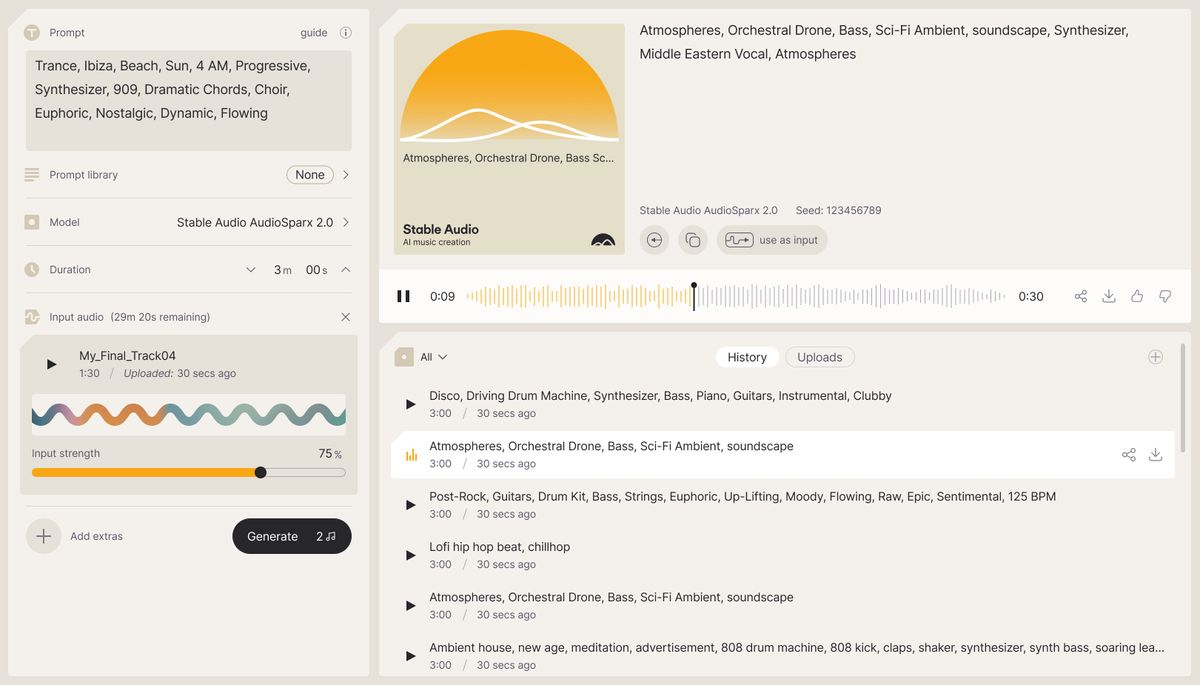
Stability AI has launched Stable Audio 2.0, an update to its AI music generator that can now produce fully structured tracks up to three minutes in length, process and transform audio uploaded by the user, and generate sound and audio effects. The company aims to enhance current production workflows and expand the creative toolkit for artists, but faces criticism over copyright concerns and the potential impact on working musicians.
Stability AI's audio generation model, Stable Audio 2.0, now allows users to upload their own audio samples to create AI-generated songs up to three minutes long, but the results are still far from Grammy-worthy. The model, trained on data from AudioSparx, offers improved features for customization but still produces songs that sound soulless and weird, with some likening the vocals to whale sounds. Despite efforts to block copyrighted material, the model's ability to create songs that sound like actual songs remains a work in progress.
Stability AI, the maker of Stable Diffusion, faces further turmoil as its CEO resigns amidst financial, legal, and credibility issues. The company's interim co-CEOs are tasked with steering the company forward, but it has already lost key developers and faced controversy over its technical model. With its future uncertain, the question remains whether Stability AI can survive and thrive in the competitive generative AI market.
Emad Mostaque, CEO of Stability AI, has resigned to pursue decentralized AI, leading to the appointment of interim co-CEOs Shan Shan Wong and Christian Laforte. Mostaque's departure follows reports of trouble at Stability AI, including the resignation of key developers and a lawsuit from Getty Images over the data used to train its flagship AI product, Stable Diffusion. Meanwhile, rival startup Inflection AI experienced a talent acquisition by Microsoft, with co-founder Mustafa Suleyman joining as CEO of a new AI team.
Emad Mostaque, CEO and founder of Stability AI, has resigned from his position and the company's board to pursue decentralized AI, citing the inability to beat centralized AI with more centralized AI. The startup, known for its popular image generation tool Stable Diffusion, has appointed its COO and CTO as interim co-CEOs. Mostaque's departure comes amid ongoing struggles at the company, including significant talent loss and unsuccessful attempts to raise new funding at a $4 billion valuation. This announcement follows a week of major changes in the AI industry, with another startup, Inflection AI, experiencing co-founder departures and staff joining Microsoft.
Key members of the artificial intelligence research team behind the Stable Diffusion model have resigned from Stability AI, marking the latest blow to the struggling company, which has seen a mass exodus of executives and faces financial challenges. The departures come as Stability AI grapples with a cash crunch, struggles to raise additional funds, and faces copyright infringement lawsuits. The company, once valued at $1 billion, has also sold off a subsidiary and experienced a decline in board support.