UVA researchers have identified a universal mathematical model, the 'powerbend distribution,' that accurately describes species abundance across various ecosystems, from trees to microbes, aiding biodiversity conservation and ecological understanding.
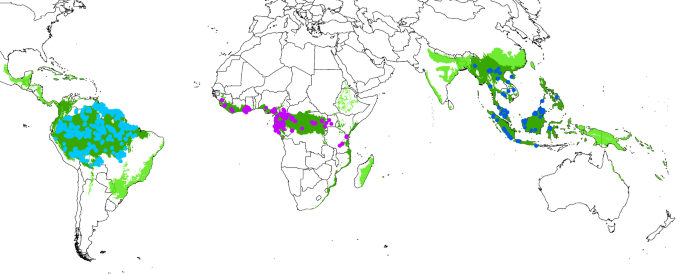
A study analyzing tree species abundance in tropical forests across Africa, Amazonia, and Southeast Asia found consistent patterns of commonness, with a small number of species comprising the majority of trees in each region. The study estimates that just over 100 species account for 50% of the trees in each region, and extrapolates these findings to suggest that approximately 1,100 tree species may dominate tropical forests worldwide. The results highlight the importance of focusing research efforts on understanding the biology of these common tree species to gain insights into tropical forest ecology and their response to environmental change.
A study led by researchers from the German Centre for Integrative Biodiversity Research, Martin Luther University Halle-Wittenberg, and the University of Florida has shed light on the global species abundance distribution (gSAD), a pattern that reveals how many species are common, rare, or fall in between. By analyzing data from the Global Biodiversity Information Facility, the researchers found that most species are rare but not extremely so, with only a few species being highly common. However, the veil of understanding remains partially lifted for many species groups, such as insects. The findings highlight the importance of biodiversity monitoring and provide insights into the ecological and evolutionary mechanisms that govern species abundance.