
Tag

Resonant Orbits

All articles tagged with #resonant orbits

astronomy2 years ago

Cosmic Harmony: A Perfectly Resonant Six-Planet System Unveiled

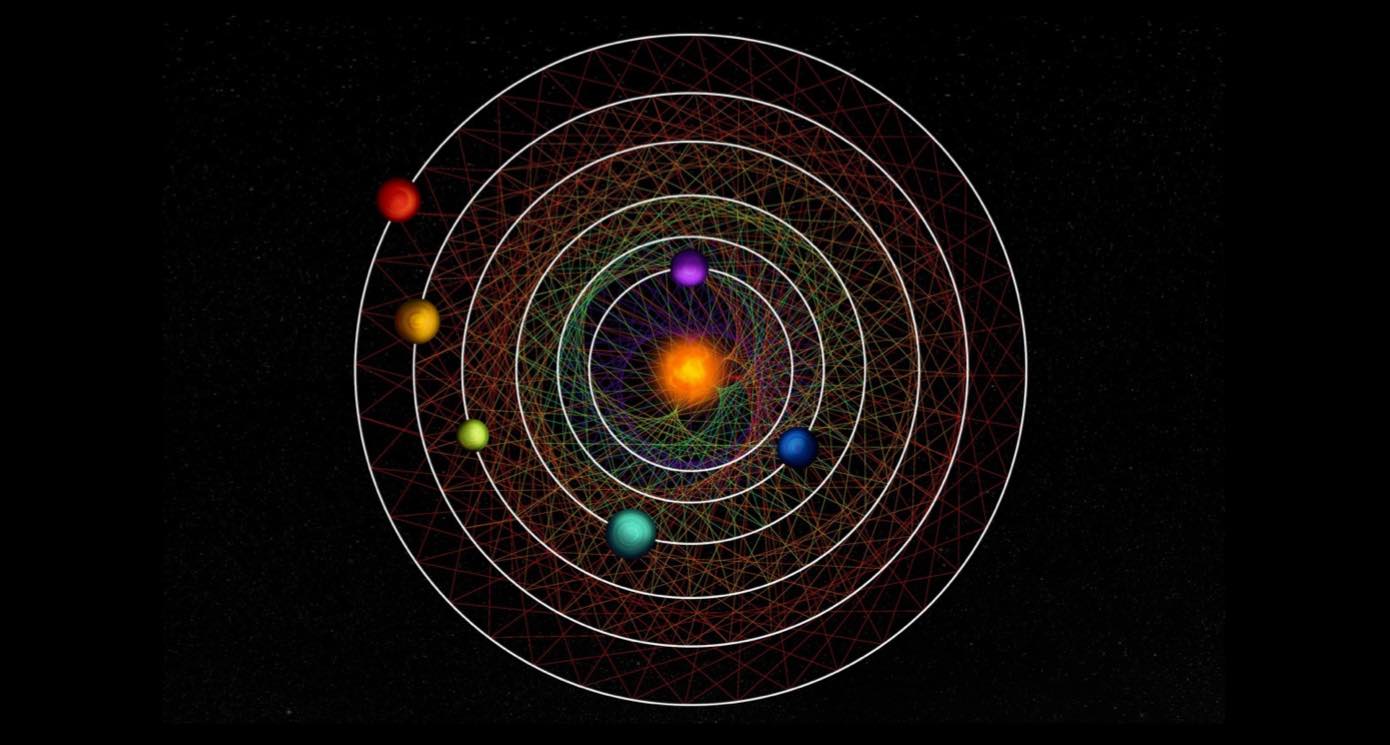
Scientists have discovered a unique star system, HD110067, where six planets orbit in a rhythmic gravitational lockstep, a rare phenomenon that could reveal new insights into planet formation and evolution. The system, located around 100 light-years away in the constellation of Coma Berenices, features planets that move in a precise orbital waltz, with some planets in a 3/2 resonance and others in a 4/3 resonance. This discovery provides an opportunity to study the formation and evolution of sub-Neptune planets, which are the most common type of planets outside our solar system.
science2 years ago

Cosmic Harmony: Unveiling the Perfectly Synchronized Six-Planet Solar System

Scientists have discovered six exoplanets in perfect resonance around the star HD 110067, indicating that their orbits have remained synchronized for billions of years. This phenomenon is typically observed during the early stages of star-and-planet system formation. The planets, known as "sub-Neptunes," are about 1 to 2 times the mass of Earth. The rarity of this resonance configuration suggests that only around 1% of multi-planet systems retain resonance. Studying this system may provide insights into the formation and preservation of resonant orbits, shedding light on the history of our own solar system.

astronomy2 years ago

"Perfectly Synced: Astronomers Uncover a Six-Planet Solar System in the Milky Way"

Astronomers have discovered a system of six planets orbiting a nearby sun-like star, HD 110067, which are locked into a rare resonance with one another. These sub-Neptune planets, larger than Earth but smaller than Neptune, provide insights into planet formation and evolution. The stable, predictable orbital pattern suggests that the planets have remained undisturbed for billions of years. While not suitable for life, the system offers valuable opportunities for studying planet atmospheres. The discovery raises questions about why our own solar system lacks sub-Neptune planets, and further investigation will be conducted using NASA's James Webb Space Telescope.