Researchers have used a 56-qubit quantum computer to generate certifiably random bits, verified by classical supercomputers, marking a significant milestone in practical quantum computing and its applications in cryptography and secure communications.
Google has claimed that its new quantum chip, Willow, may be tapping into parallel universes to achieve unprecedented computational speeds, completing tasks in minutes that would take supercomputers septillions of years. This assertion, based on the multiverse hypothesis, has drawn skepticism, as the specific calculation performed has no practical use and similar claims in the past have been contested. Despite the impressive scientific achievement, practical applications remain distant, with experts suggesting that a million qubits are needed for useful quantum computing.
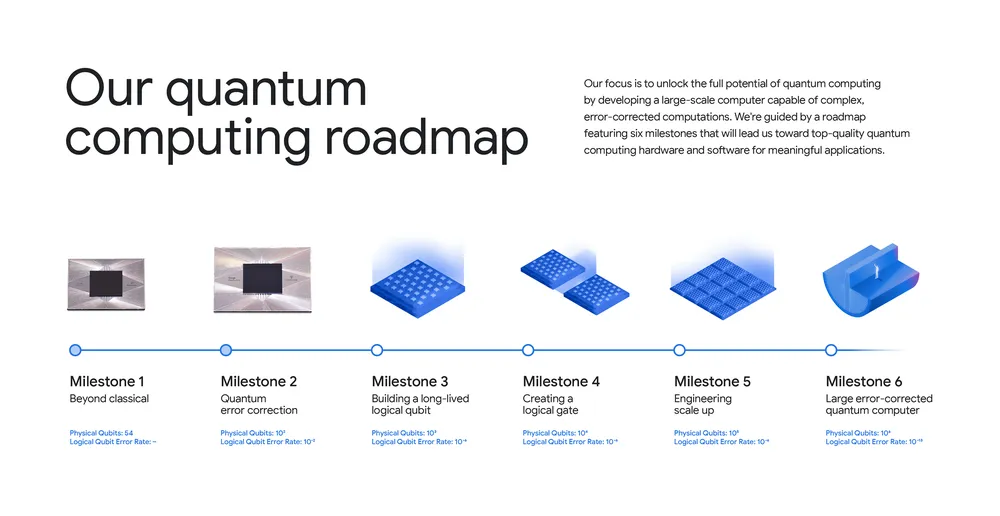
Google has unveiled its latest quantum chip, Willow, which focuses on reducing errors by incorporating more qubits, rather than claiming quantum supremacy as it did controversially in 2019. The company continues to use random circuit sampling (RCS) as a performance metric, despite its lack of real-world applications, while competitors like IBM and Honeywell use quantum volume for a more comprehensive assessment of quantum computing capabilities.
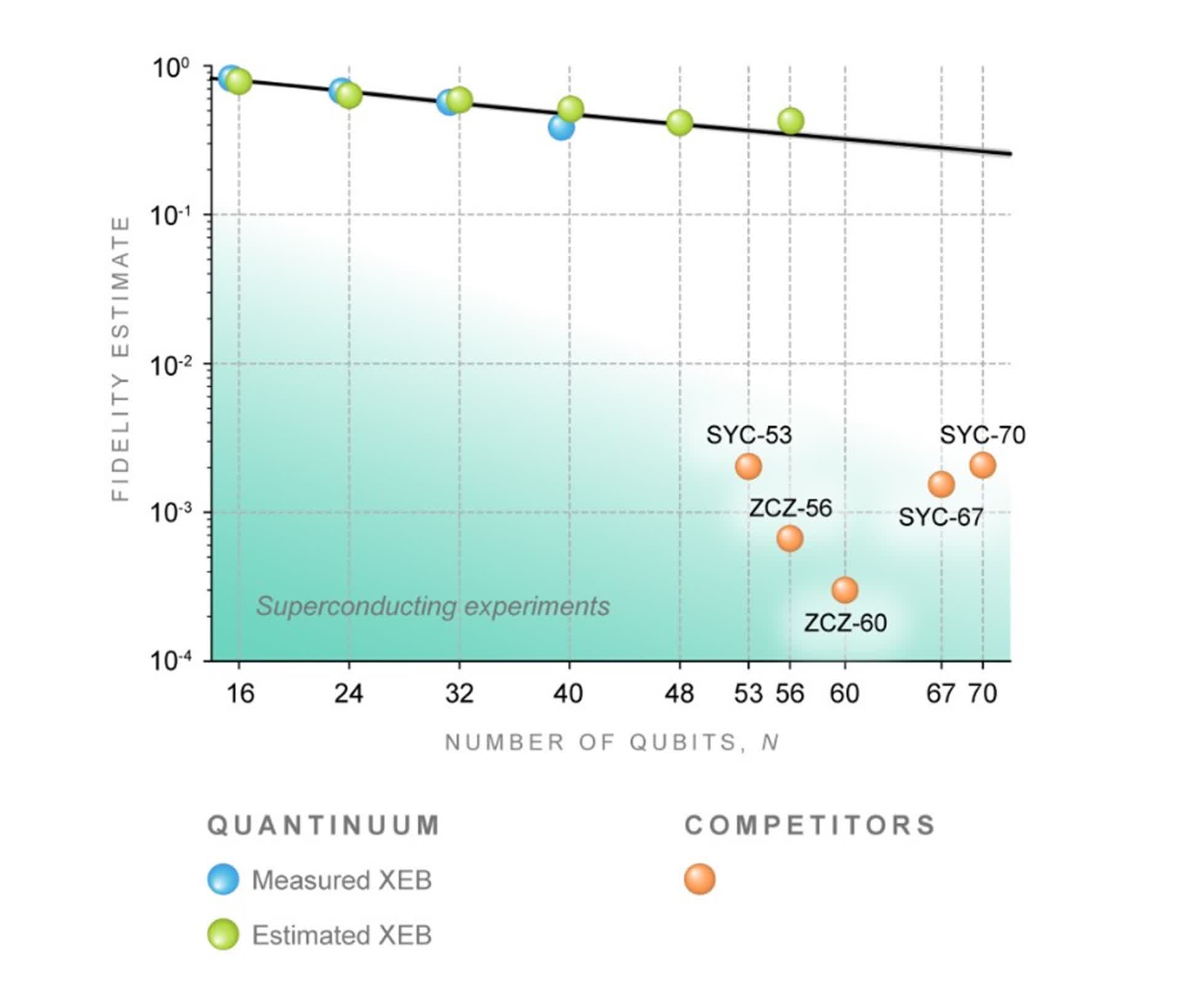
Quantinuum's new 56-qubit H2-1 quantum computer has surpassed Google's Sycamore by achieving a 100-fold improvement in quantum supremacy. The H2-1 demonstrated significant advancements in error correction, achieving a linear cross entropy benchmark (XEB) score of ~0.35 and creating highly reliable logical qubits. This milestone represents a major step towards fault-tolerant quantum computing, with error rates up to 800 times lower than physical qubits. Quantinuum's results, published on arXiv, have not yet been peer-reviewed.
A recent study by Ramis Movassagh, a researcher at Google Quantum AI, mathematically demonstrates the difficulty of simulating random quantum circuits and estimating their outputs for classical computers. The study shows that this task is highly challenging, known as #P-hard, and provides computational barriers for the classical simulation of quantum circuits. Movassagh's proof, based on new mathematical techniques, is direct and does not involve approximations, allowing for explicit error bounds and quantification of robustness. The research contributes to ongoing efforts to explore the advantages of quantum computers over classical computers and could inform future studies in quantum cryptography and complexity theory.