Prima: a health-system-scale MRI foundation model reshaping neuroimaging
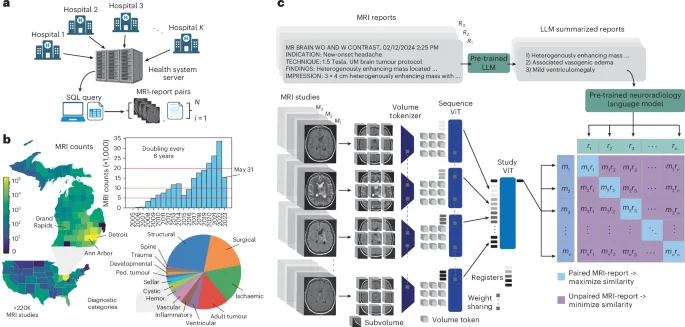
A team trains Prima, a health-system-scale AI foundation model for MRI, using over 220,000 studies. In a one-year, system-wide study (29,431 MRIs across 52 neurologic diagnoses), Prima achieves a mean AUC of 92.0%, outperforming state-of-the-art models, and offers explainable predictions, radiologist worklist prioritization, and clinical referral recommendations. The model demonstrates algorithmic fairness across sensitive groups and leverages a hierarchical ViT with a VQ-VAE-based volume tokenizer and CLIP objective, aided by LLM-assisted report summarization. Data originates from the University of Michigan with MIT-licensed code; data sharing is governed by IRB and institutional agreements. Overall, the work showcases health system-scale AI training as a pathway to faster, fairer AI-driven neuroimaging in clinical care.