
Researchers at the University of Limerick have developed a method to grow organic crystals for energy-harvesting using piezoelectricity from amino acids. This eco-friendly approach could replace lead-based materials in electronics, reducing environmental impact. The technique involves shaping crystals with silicon molds, potentially powering devices through everyday forces. This innovation, published in Physical Review Letters, offers a sustainable alternative to traditional piezoelectric materials, with significant implications for consumer electronics and medical devices.
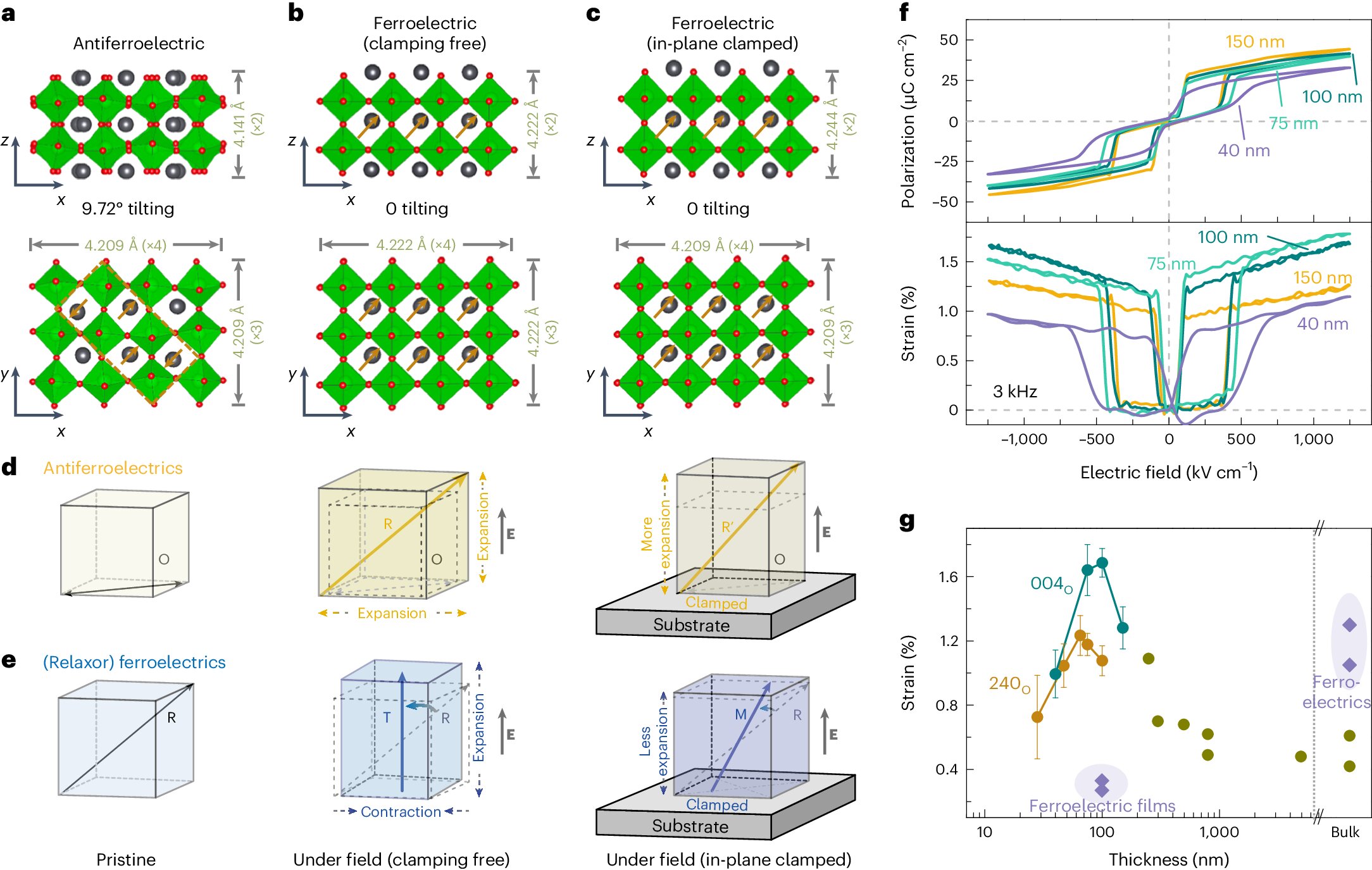
Researchers from Rice University and UC Berkeley have discovered that antiferroelectric materials, specifically lead zirconate (PbZrO3), can outperform conventional piezoelectric materials in miniaturized electromechanical systems. These materials exhibit up to five times greater electromechanical response even in extremely thin films, overcoming performance limitations due to clamping. This breakthrough could lead to the development of more efficient and powerful microelectromechanical and nanoelectromechanical systems.
Researchers from Michigan State University have discovered a liquid with piezoelectric characteristics, which could be used to create electrically controlled optics or even a new field of piezo-hydraulics. The liquid was discovered when working with a pair of ionic liquid salts that hold their liquid state at room temperature. Prior to this discovery, it was believed that piezoelectric materials were only crystalline and lacked inversion symmetry. The discovery will likely require some modification of current solid-state piezoelectric theory and the liquids are more environmentally friendly than solid-state piezoelectric materials.