A YouTuber named [Dave] creates a high-tech 'Marauder’s Map' for his hardware store by using 3D scanning, multiple CCTV feeds, and NVIDIA's Deep Stream AI pipeline to track human movement across the store, demonstrating how advanced technology can mimic magical surveillance.
Researchers at Fuzhou University have developed a revolutionary machine vision sensor using quantum dots that can adapt to lighting changes in just 40 seconds, mimicking human eye behavior, improving energy efficiency, and enhancing robotic and autonomous vehicle capabilities in various environments.
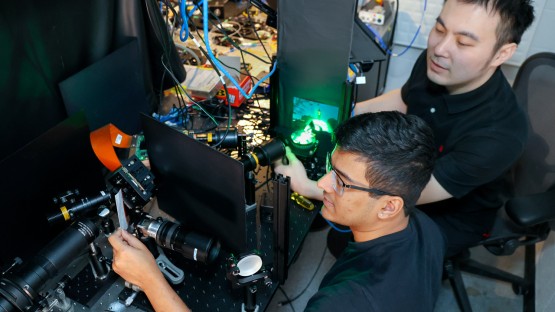
Researchers at Cornell University have developed an optical neural network (ONN) that can filter relevant information from a scene before the visual image is detected by a camera, making it possible to build faster, smaller and more energy-efficient image sensors. The ONN pre-processors can achieve compression ratios of up to 800-to-1 while still enabling high accuracy across several representative computer-vision tasks. The researchers believe their work could have practical applications in fields such as early cancer detection research, where cancer cells need to be isolated from millions or billions of other cells.
To calibrate a thermal camera for machine vision tasks, a geometric calibration is needed to correct for lens distortion. Generating a geometrically-regular thermal pattern is key to this process, which can be achieved using methods such as a grid of nichrome wires, discs of cold aluminium, or a simple checkerboard. Mathematical techniques are then used for calibration based on these patterns.