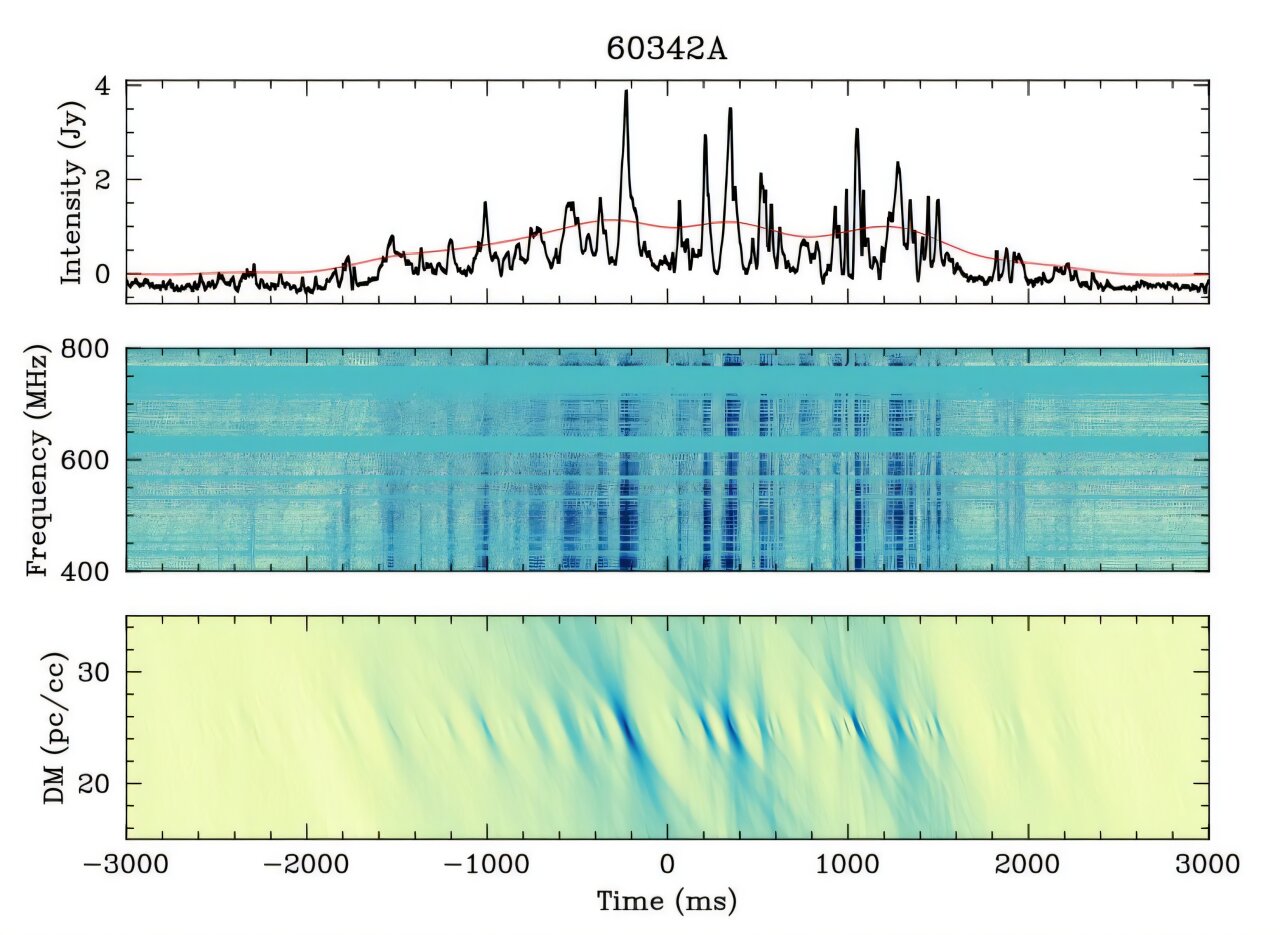
Astronomers have discovered a new long-period radio transient, CHIME J1634+44, notable for its circular polarization and accelerating spin period, which may be linked to binary activity or gravitational waves, providing new insights into the nature of such transients.
Scientists from The University of New Mexico and MIT have detected and validated two of the longest-period exoplanets found by TESS to date. These warm Jupiters orbit a K dwarf star and offer exciting research opportunities for understanding planet formation. The exoplanets, TOI-4600 b and c, have orbital periods of 82.69 days and 482.82 days, respectively, making TOI-4600 c the longest-period planet found by TESS so far. The discovery was made using photometric data from TESS and confirmed through ground-based observations. The findings contribute to the understanding of exoplanet systems and the formation of different types of planets.