Oxford scientists have simulated how ultra-powerful lasers can stir the quantum vacuum, leading to the creation of light from 'nothing,' a phenomenon predicted by quantum theory, and paving the way for experimental verification and potential dark matter detection.
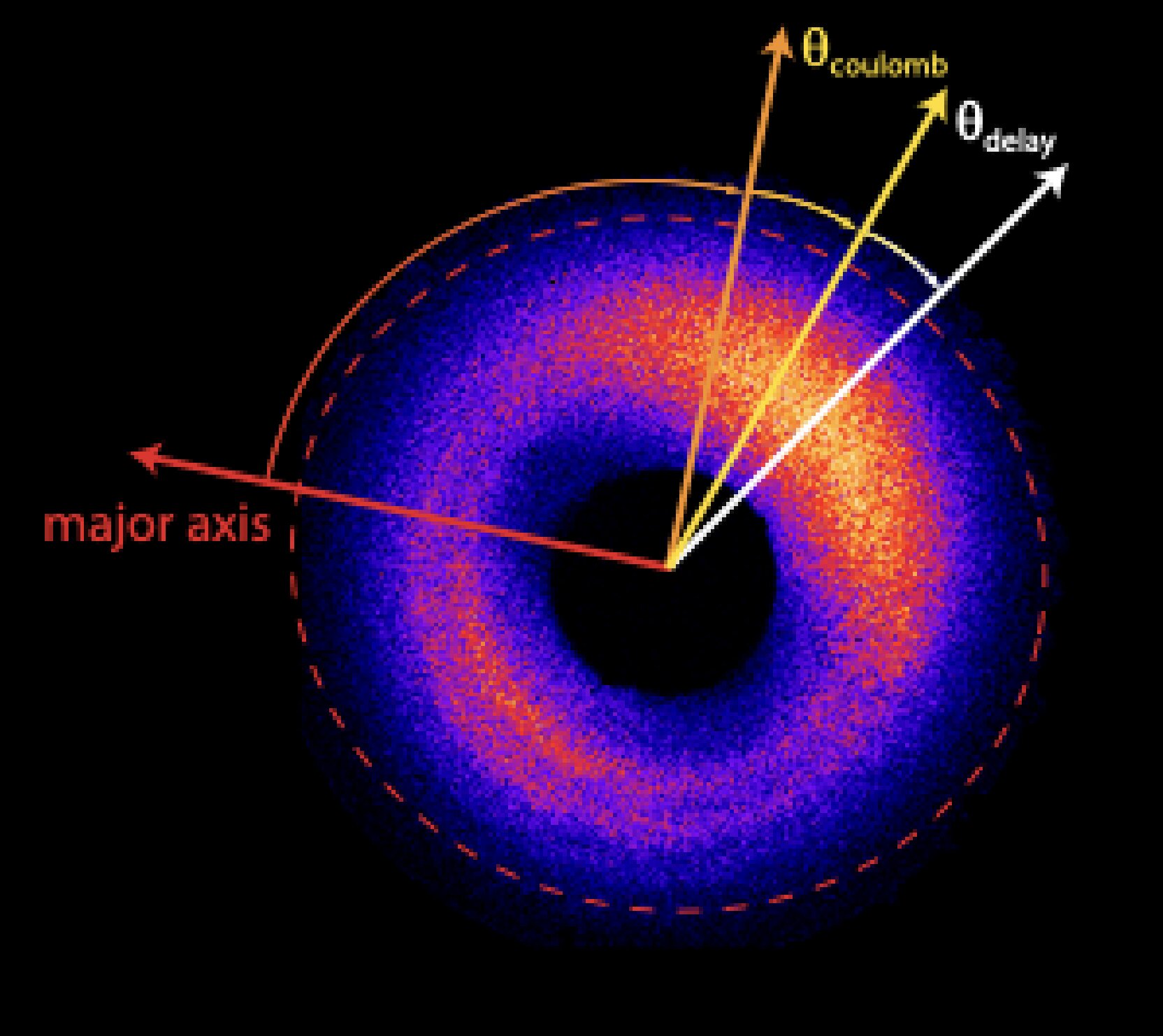
Researchers at Wayne State University and Sorbonne University have developed a new phase-resolved attoclock technique that allows for more precise measurement of electron tunneling time during strong-field ionization, suggesting that the tunneling time is extremely short and opening new avenues for studying ultrafast quantum phenomena.
Researchers have developed nanophotonic electron accelerators, the size of a computer chip, using lasers to speed up electrons. This breakthrough could lead to miniaturized particle accelerators with lower costs and greater portability. The team at Friedrich-Alexander-Universität Erlangen-Nürnberg (FAU) successfully demonstrated the first nanophotonic electron accelerator, achieving a 43% gain in energy. The ultimate goal is to develop a particle accelerator on a chip for medical applications, such as direct internal radiotherapy. This achievement was also simultaneously demonstrated by researchers at Stanford University, with both teams collaborating on the "Accelerator on a chip" project funded by the Gordon and Betty Moore Foundation.
Researchers at Friedrich-Alexander-Universität Erlangen-Nürnberg (FAU) have successfully demonstrated the first nanophotonic electron accelerator, using lasers to accelerate electrons within a photonic nanostructure. The accelerator, which is as small as a computer chip, achieved a 43% gain in energy, marking a significant milestone in the field of accelerator physics. The ultimate goal is to further increase energy gain and electron current to make the particle accelerator on a chip suitable for medical applications.
Laser physicists have directly observed the first few femtoseconds after photoinjection with a strong laser pulse, revealing how the optical properties of silicon and silicon dioxide evolve during this time. The attoworld team of LMU and the Max Planck Institute of Quantum Optics used a novel technique for optical-field-resolved pump-probe measurements to observe how charge carriers interacted with a weak test pulse during the first femtoseconds after their appearance. The findings could eventually help achieve future signal processing in the petahertz range, making so-called light wave electronics possible.