

Tag

Attosecond Science

All articles tagged with #attosecond science

science-and-technology2 years ago

Unveiling the Potential of Attosecond-Scale 'Movies' for Advancing Super-Fast Electronics

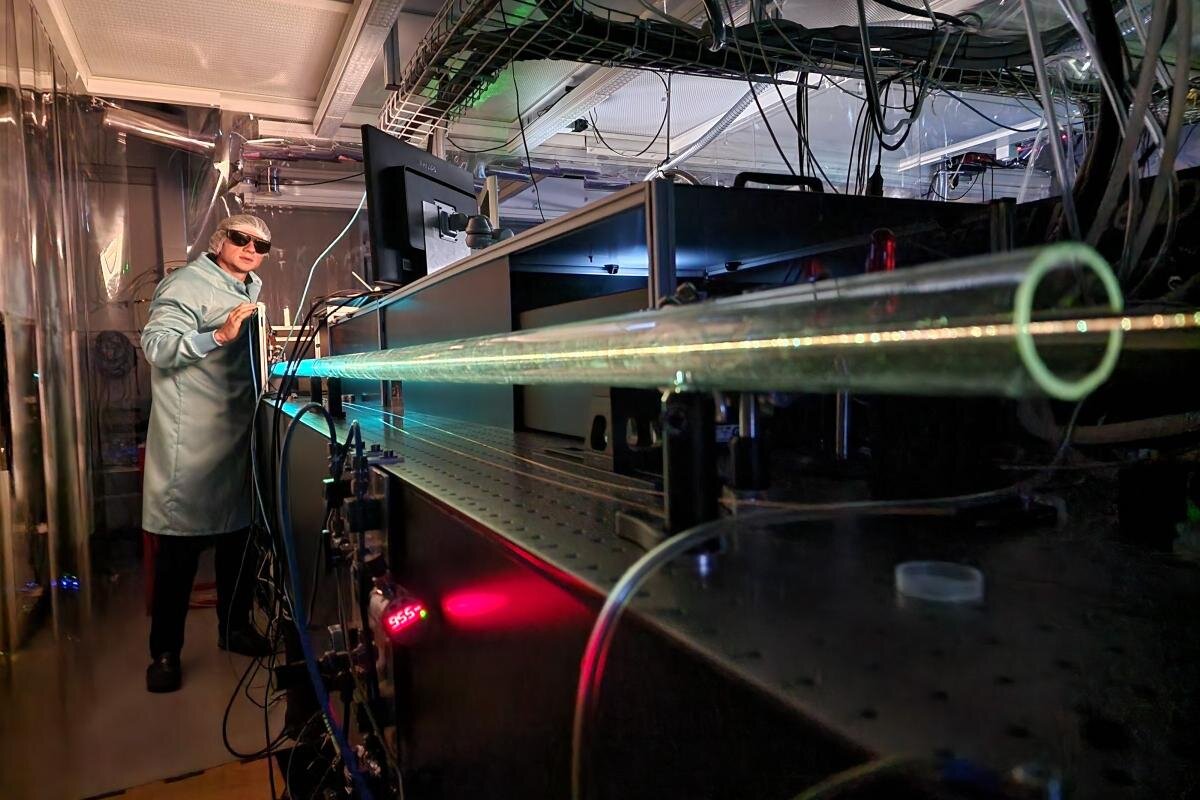
Scientists awarded the 2023 Nobel Prize in physics have made significant contributions to attosecond science, which involves capturing the ultrafast motion of electrons using attosecond laser pulses. By using these pulses as strobes, researchers can create "attosecond movies" of electron behavior, providing fundamental insights into their motion. This understanding could lead to advancements in controlling chemical reactions, engineering new molecules, and developing ultrafast switches for faster electronics. Attosecond science also holds potential applications in EUV lithography and the study of particle motion on even faster timescales.

science-and-technology2 years ago

Nobel Prizes Recognize Groundbreaking Discoveries in Physics and Medicine

The Nobel Prize in Physics has been awarded to Pierre Agostini, Ferenc Krausz, and Anne L’Huillier for their groundbreaking work on techniques that allow scientists to capture the movements of electrons, shedding light on the subatomic realm. By using short light pulses lasting only attoseconds (one quintillionth of a second), the scientists have been able to study the relative positions of electrons in atoms and molecules. This breakthrough in attosecond science has the potential to advance fields such as circuitry, drug design, and medical diagnostics, and provides physicists with a new tool to explore the microscopic world.

science-and-technology2 years ago

Observing the First Femtoseconds of Photoinjection with Laser Physics

Laser physicists have directly observed the first few femtoseconds after photoinjection with a strong laser pulse, revealing how the optical properties of silicon and silicon dioxide evolve during this time. The attoworld team of LMU and the Max Planck Institute of Quantum Optics used a novel technique for optical-field-resolved pump-probe measurements to observe how charge carriers interacted with a weak test pulse during the first femtoseconds after their appearance. The findings could eventually help achieve future signal processing in the petahertz range, making so-called light wave electronics possible.