Famed investor Michael Burry warned that a Bitcoin selloff could intensify into a self-reinforcing “death spiral,” potentially harming corporate holders, miners, and crypto stocks, per Bloomberg via his Substack post.
Genesis, a struggling crypto-lending company, sold off 36 million shares of GBTC to acquire 32,041 BTC, valued at $2.1 billion, in a bid to address financial challenges and potential bankruptcy. This move was likely prompted by the desire to capitalize on the recent surge in Bitcoin prices and to settle debts with creditors. As Bitcoin's fourth halving approaches, whales are accumulating BTC, hinting at a bullish outlook. Analysts, including Anthony Scaramucci, anticipate a significant upside for Bitcoin post-halving, with a potential surge of six to ten times, although not immediately.
Ark Invest's 21shares's spot Bitcoin ETF, ARKB, experienced net daily outflows of $87.5 million on April 2, surpassing Grayscale's GBTC for the first time. Since the SEC approved multiple spot Bitcoin ETFs in January, Grayscale has consistently seen investors withdraw funds due to lower fees charged by other ETFs. With the upcoming halving of Bitcoin's supply, some analysts speculate that ETFs' demand for BTC could lead to a supply crunch and drive up its price, while others argue against the idea of an ETF-led "supercycle."
Grayscale's Bitcoin Trust (GBTC) is projected to deplete its Bitcoin reserves within the next 96 days due to consistent outflows, with its balance dropping by 266,470 BTC since January. The outflows are attributed to profit-taking investors, arbitragers, and high fees. Grayscale's CEO acknowledged the anticipated outflows and mentioned plans to introduce a mini fund and reduce the 1.5% fee to counteract the trend.
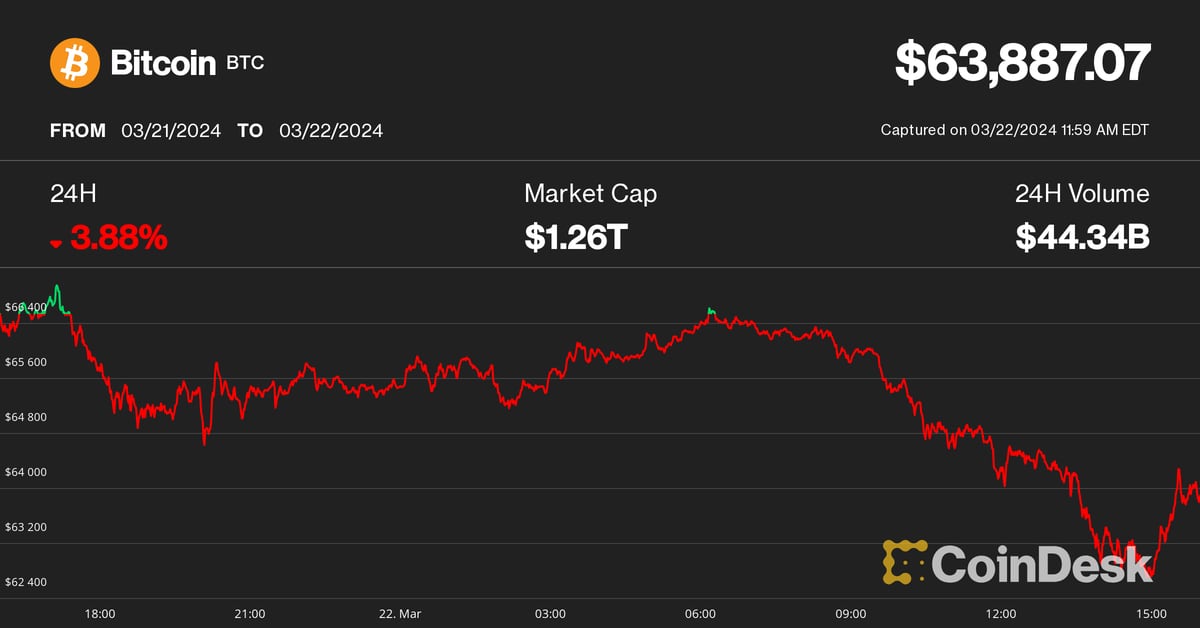
Bitcoin slipped to below $63,000 amid a broader crypto sell-off, with the price currently at $64,000, down 3.7% over the past 24 hours. Large outflows from the Grayscale Bitcoin Trust (GBTC) have contributed to the sell-off, with nearly all U.S.-listed spot bitcoin ETFs experiencing net negative flows for four consecutive days. Analysts believe that once the GBTC selling is completed, ETF inflows could pick up again due to favorable macro conditions and central bank policy.
Despite the recent approval of Bitcoin ETFs, the surge in institutional investors and heightened investor interest are seen as key drivers of Bitcoin’s demand and supply, with ETFs potentially having an indirect impact on Bitcoin’s price through increased adoption and market validation. GBTC outflows totaling $1.4 billion in a week’s time suggest increased investor interest, while the complex price trajectory of Bitcoin indicates that factors beyond ETF inflows are playing a significant role in its price movements.
Grayscale has filed an application with the SEC for a new spinoff product called the Bitcoin Mini Trust, which will use the $BTC ticker and be seeded with GBTC shares. The proposed ETF aims to have a lower fee structure compared to existing options and is not expected to trigger a taxable event for GBTC holders. Grayscale's move comes as GBTC has seen significant outflows following the launch of other Bitcoin ETFs, with the company aiming to make Bitcoin more widely accessible. If approved, the Bitcoin Mini Trust will be established as a separate entity from GBTC.
Grayscale has filed for a new Bitcoin ETF product, the Grayscale Bitcoin Mini Trust, in an effort to offset the outflows from its Grayscale Bitcoin Trust (GBTC). The new fund will be seeded as a "Spin-Off" of GBTC, diverting some of its Bitcoin stash, and existing GBTC shareholders will receive a proportional number of BTC shares. Analysts believe this move aims to address investors' preference for lower fees offered by competitors, as Grayscale continues to charge 1.5% compared to 20-30 basis points by others. Lowering fees would impact Grayscale's revenue, so the "Spin-Off" approach is seen as a middle ground to attract new investors while maintaining revenue.
Grayscale has filed an S-1 form with the SEC to register a mini version of its Grayscale Bitcoin Trust (GBTC), called the Grayscale Bitcoin Mini Trust, which is intended to offer additional exposure to bitcoin for investors without incurring extra taxes. The mini trust, operating independently from GBTC, will be listed on the NYSE and distributed to GBTC shareholders as GBTC contributes a certain amount of bitcoin to the trust. The move comes as Grayscale's market share of cumulative spot bitcoin ETF trading volume dropped to its lowest point, with BlackRock and Fidelity's ETFs accounting for 69% of the total trading volume.
Bitcoin rose nearly 4% to $41,362.64 as concerns about outflows from the Grayscale Bitcoin ETF (GBTC) eased, with analysts noting a slowdown in redemptions. Ether also saw a 1.5% increase, but is on track for a 10% weekly decline. Despite a sharp drop earlier in the week, Bitcoin-related equities have outperformed the cryptocurrency, with Coinbase, Riot Platforms, and Marathon Digital all set to end the week with gains.
Grayscale's Bitcoin Trust (GBTC) has moved over 100,000 BTC to exchanges since the launch of spot bitcoin ETFs, with the majority going to Coinbase Prime for potential sale. The outflows may not all be related to redemption, as some could be settlements of trading activity. Grayscale's management fee cut and AUM decline have contributed to the massive outflow, putting pressure on bitcoin's price, which recently dropped below $40,000. Despite hopes of a slowdown in GBTC exits after FTX's sale, the movement of 19,000 BTC to exchanges indicates ongoing selling pressure.
The poor price performance of Bitcoin since the launch of U.S.-based spot ETFs has been partly attributed to sizable sales of Bitcoin from the Grayscale Bitcoin Trust (GBTC). However, a report revealed that the bankruptcy estate for failed crypto exchange FTX sold its entire 22 million share holding of GBTC for nearly $1 billion, indicating that more than one-third of the selling of GBTC was due to one non-economic actor. This news suggests that there was nearly $1 billion more of fresh investment into the new spot ETFs than previously thought, providing a bullish outlook for Bitcoin despite its current lower price.
JPMorgan analysts predict that Grayscale's GBTC could see an additional $1.5 billion in sales as traders exit the space following the ETF conversion, putting pressure on bitcoin prices. The bank warns that if GBTC loses its liquidity advantage, an additional $5 billion-$10 billion could exit the fund. Meanwhile, other spot bitcoin ETFs have attracted $3 billion in inflows in just four days, reflecting a rotation from existing bitcoin vehicles such as futures-based ETFs.
Bitcoin institutional investment vehicles, including Bitcoin exchange-traded funds (ETFs) and the Grayscale Bitcoin Trust (GBTC), are experiencing increased trading volume as anticipation grows over potential regulatory changes in the United States. The ProShares Bitcoin Strategy ETF (BITO) and GBTC saw significant trading volume, with BITO trading $1.7 billion and GBTC trading $800 million. The reduced discount of GBTC to the Bitcoin spot price suggests renewed interest in institutional investment options. The data indicates a resurgence in demand for Bitcoin investment vehicles, potentially signaling a growing audience for spot ETFs.
Bitcoin approaches $28,000 as Grayscale's hopes for a spot ETF are revived after the SEC decides not to appeal a court ruling that criticized its initial rejection of Grayscale's Bitcoin ETF filing. The discount on Grayscale's Bitcoin Fund (GBTC) has decreased to 15.8%, the lowest since late 2021. Solana, an "Ethereum killer," sees a 5% increase in value, while Binance's BNB token rises by almost 3% after a $450 million burn of tokens. The wider cryptocurrency market gains 2.4%, adding $24.8 billion to the total market cap.