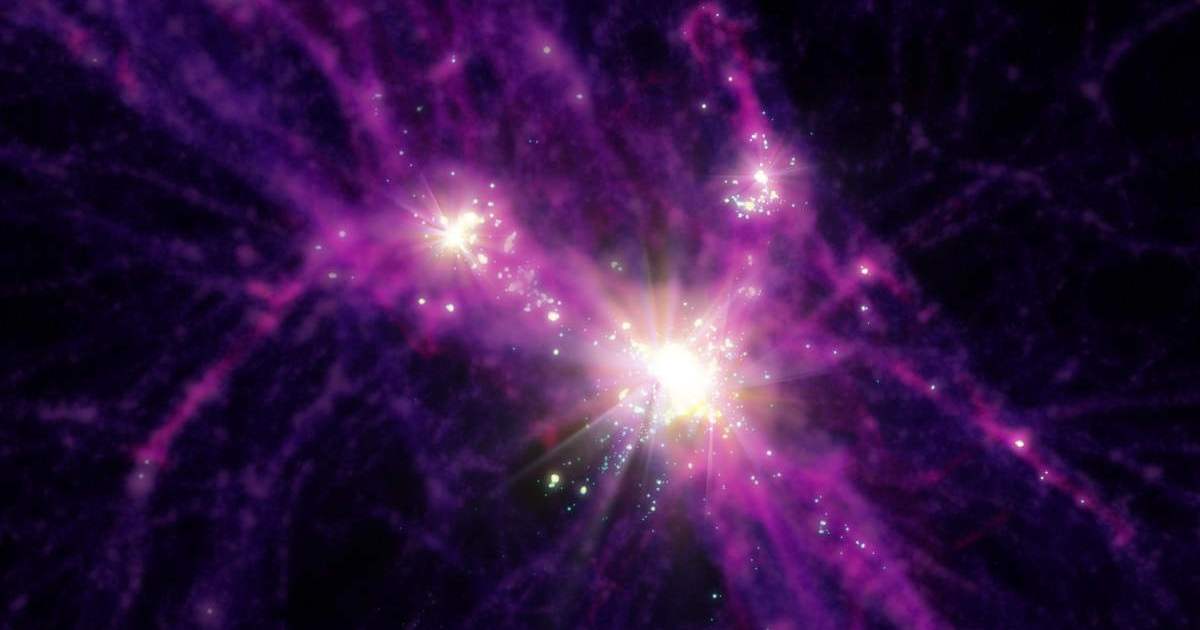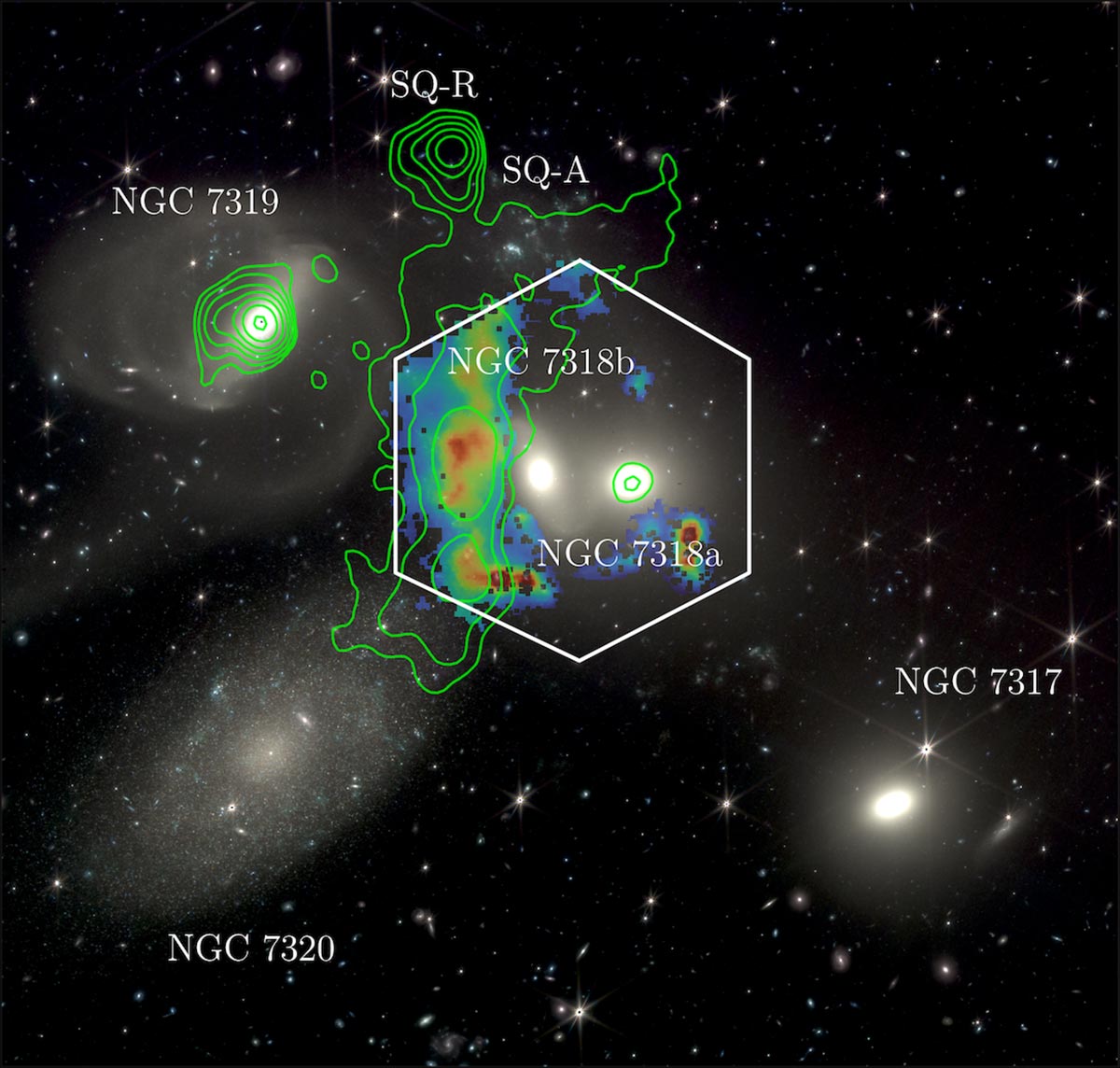
The WEAVE telescope has captured a high-speed galactic collision in Stephan's Quintet, revealing powerful shockwaves and dynamic interactions that provide insights into galaxy evolution. This event, involving a galaxy moving at 2 million mph, highlights the capabilities of advanced astronomical tools like WEAVE, LOFAR, and the James Webb Space Telescope. The collision, observed by an international team, offers a detailed view of the chaotic processes in intergalactic space and promises to enhance our understanding of the universe's evolution.
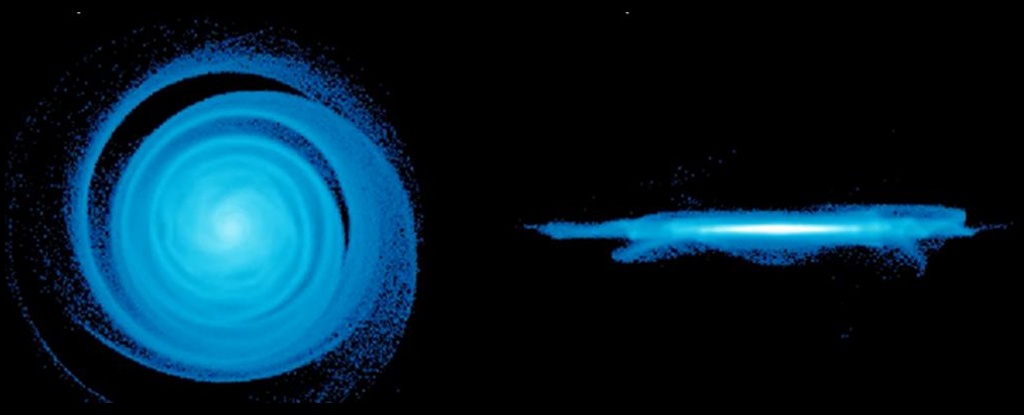
Astronomers using the ALMA telescope have observed unique pond-like ripples in the gaseous disk of BRI 1335-0417, the oldest known spiral galaxy, over 12 billion years old. These ripples suggest recent disturbances, possibly from interactions with another galaxy or a massive gas cloud, which could explain the galaxy's rapid star formation rate. Additionally, a central bar was detected, which is significant as it challenges previous theories on bar formation in galaxies, indicating that bars can form early in the universe through a star-forming gaseous bar rather than from a pre-existing stellar disk. This discovery, published in the Monthly Notices of the Royal Astronomical Society, provides new insights into galaxy formation and evolution.
The Universe's star formation peaked in its first few billion years and has since plummeted, with the current rate being the lowest in over 13 billion years. Early stars were massive and metal-free, forming in a denser Universe, but over time, factors like the uniformity of matter distribution, gravitational forces, and cosmic expansion influenced the rate of star formation. Major mergers of galaxies triggered significant starbursts, but as the Universe expanded and dark energy became dominant, the formation of large-scale structures beyond galaxy clusters was limited. Today, star formation continues at a much slower pace, with dark energy and other factors preventing the creation of new stars at the rates seen in the past. The James Webb Space Telescope (JWST) and other instruments are helping to reduce uncertainties in our understanding of the Universe's star formation history.
Scientists have resolved a longstanding mystery regarding the distribution of galaxies in the Local Supercluster by using the SIBELIUS simulation. The study found that the segregation of elliptical and disk galaxies within the supergalactic plane occurs naturally due to environmental differences, with dense regions fostering mergers and the formation of elliptical galaxies, while isolated areas allow disk galaxies to maintain their structure. This finding supports the standard model of dark matter and enhances our understanding of galaxy evolution.
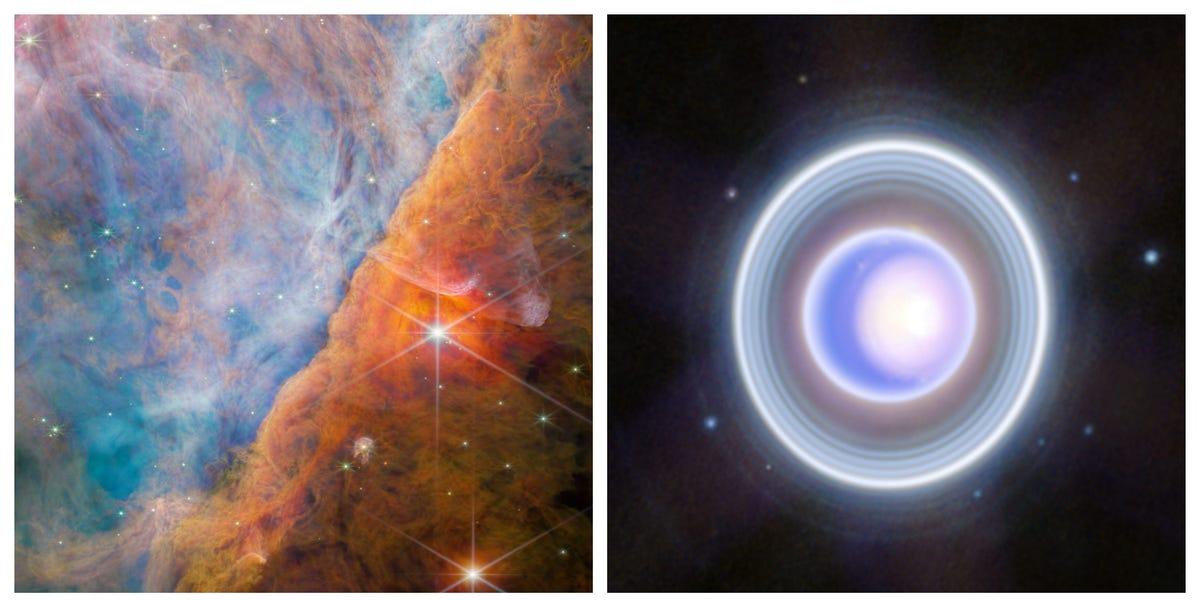
NASA's James Webb Space Telescope has captured 13 groundbreaking images in 2023, offering new insights into the universe. Highlights include the most distant black hole ever detected, located 13.2 billion light-years away, and the Ring Nebula in unprecedented detail, revealing a secret star missed by Hubble. These images have advanced our understanding of star formation, galaxy evolution, and the early universe, while also raising new questions for astronomers.
The James Webb Space Telescope (JWST) is using redshift analysis and advanced imaging to study galaxy evolution in the early universe. By analyzing light from distant galaxies, astronomers can determine their age and the conditions of the early universe. The JWST's NIRCam and NIRSpec instruments have identified galaxies with high photometric redshifts, including one at redshift 11.4, corresponding to when the universe was just 390 million years old. These findings underscore the importance of spectroscopic data for confirming the distances and properties of these early galaxies, enhancing our understanding of cosmic history.