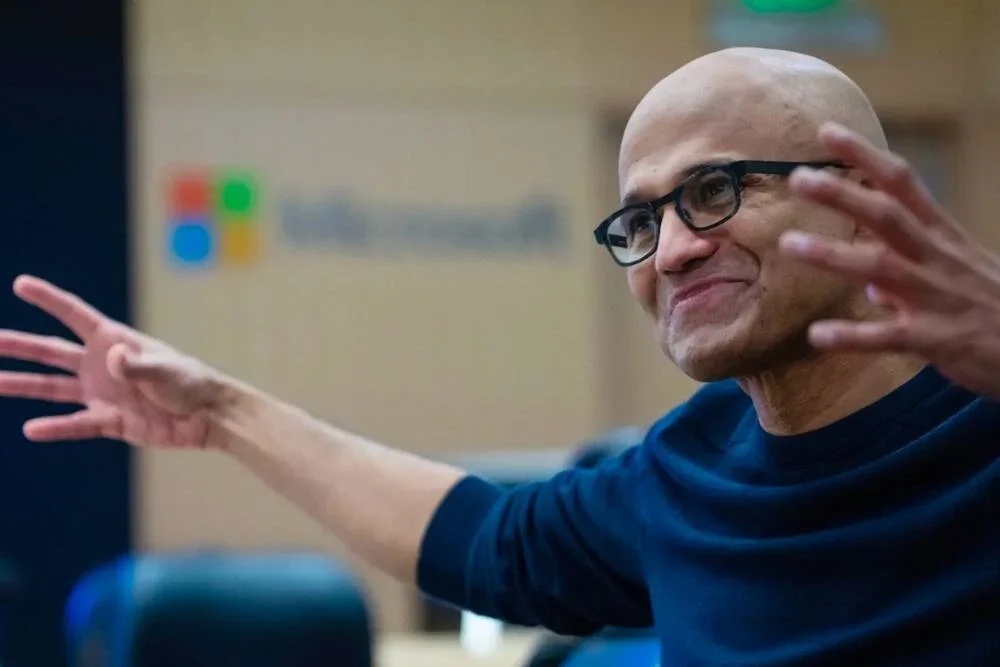
Microsoft CEO Satya Nadella emphasizes the importance of advancing AI by focusing on human empowerment, developing AI systems that work collaboratively, and making societal decisions to maximize AI's real-world impact, as the industry moves beyond initial discovery into widespread adoption.
In 2025, AI, especially large language models, has become ubiquitous, deeply integrated into daily life and society, raising questions about its regulation and long-term impact on the planet, with ongoing debates about its potential benefits and risks.
Originally Published 5 months ago — by Hacker News
The article discusses the current state and future prospects of AI, highlighting that leading models like GPT-5 and others are becoming more similar in performance, challenging the winner-take-all narrative. It explores the limitations of LLMs, the potential impact of AGI, societal and economic implications, and the importance of domain-specific AI tools over true general intelligence. The conversation also covers voice interfaces, memory in AI, and the risks associated with advanced AI development, emphasizing that while AGI may not be imminent, AI's transformative potential is undeniable.
Originally Published 6 months ago — by Hacker News
The article debates the realistic timeline and definition of Artificial General Intelligence (AGI), criticizing claims that AGI is imminent and highlighting the current limitations of large language models (LLMs). It emphasizes that LLMs are good at language but poor at logic and spatial reasoning, and argues that true AGI would require AI to outperform a small percentage of human specialists across all tasks. The discussion also touches on societal impacts, the nature of intelligence, and the challenges of defining and achieving AGI, with many experts expressing skepticism about the near-term arrival of true AGI.
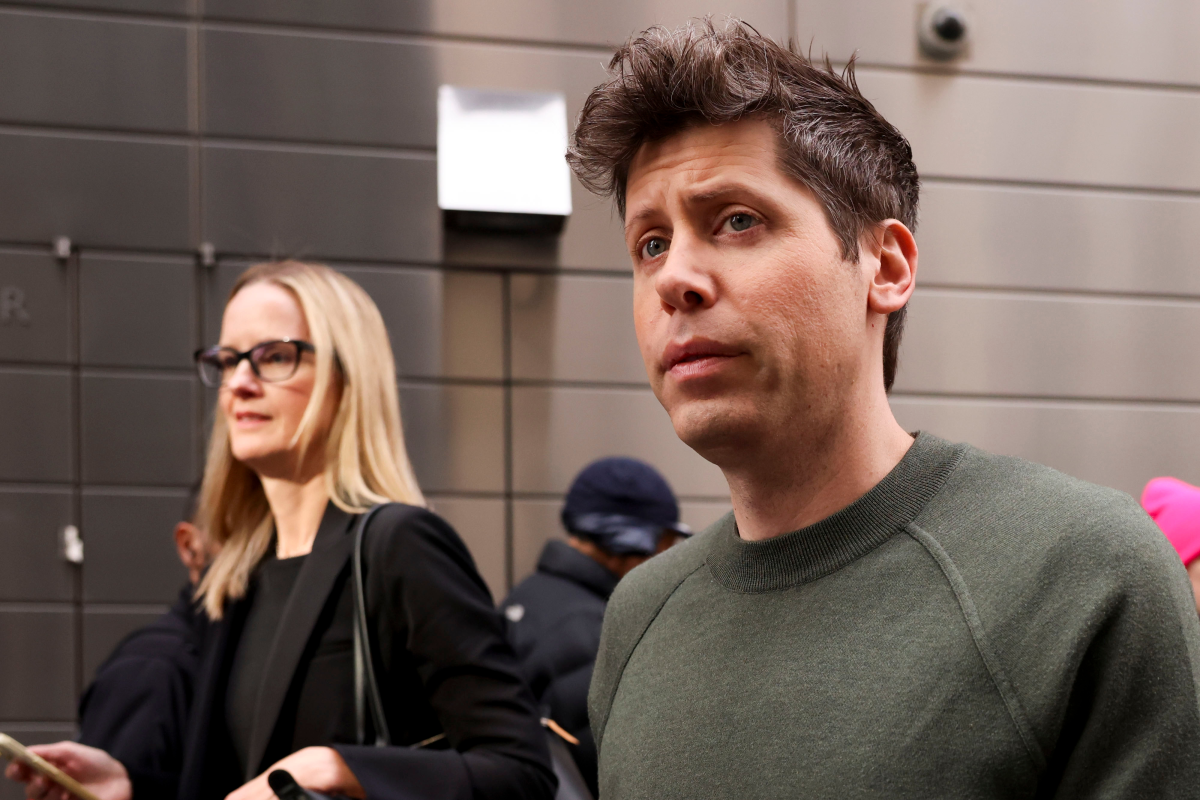
OpenAI CEO Sam Altman declares that humanity has entered the era of artificial superintelligence, with rapid advancements predicted to transform society by 2027, raising both opportunities and existential safety concerns, especially around aligning superintelligent systems with human values.
OpenAI CEO Sam Altman predicts that by 2026, AI systems will likely be capable of generating novel insights, reflecting a focus on developing AI that can contribute original ideas to science and other fields, amidst ongoing skepticism about AI's creative capabilities.
Agentic AI refers to autonomous artificial intelligence systems capable of independently making decisions and taking actions to achieve goals, moving beyond passive tools to proactive agents that can sense, decide, and act without human input, with applications across various industries and potential risks and benefits.
OpenAI's internal strategy document reveals plans to evolve ChatGPT into a 'super assistant' that deeply understands users and serves as their primary interface to the internet, aiming to revolutionize online interaction and assist with a wide range of tasks, with a focus on building monetizable demand and infrastructure support in 2025.
OpenAI plans to evolve ChatGPT into a 'super assistant' by 2025, aiming for it to deeply understand users and assist with a wide range of tasks, positioning it as a companion and integral part of daily life.
Computer scientist Binny Gill argues that the pursuit of artificial general intelligence (AGI) is misguided and instead advocates for the development of artificial narrow intelligence (ANI) by offloading mental labor, similar to how the industrial age offloaded manual labor. Gill believes that even if machines achieve superhuman abilities, human oversight will still be necessary to make ethical decisions, likening it to needing an "Iron Man inside the suit."
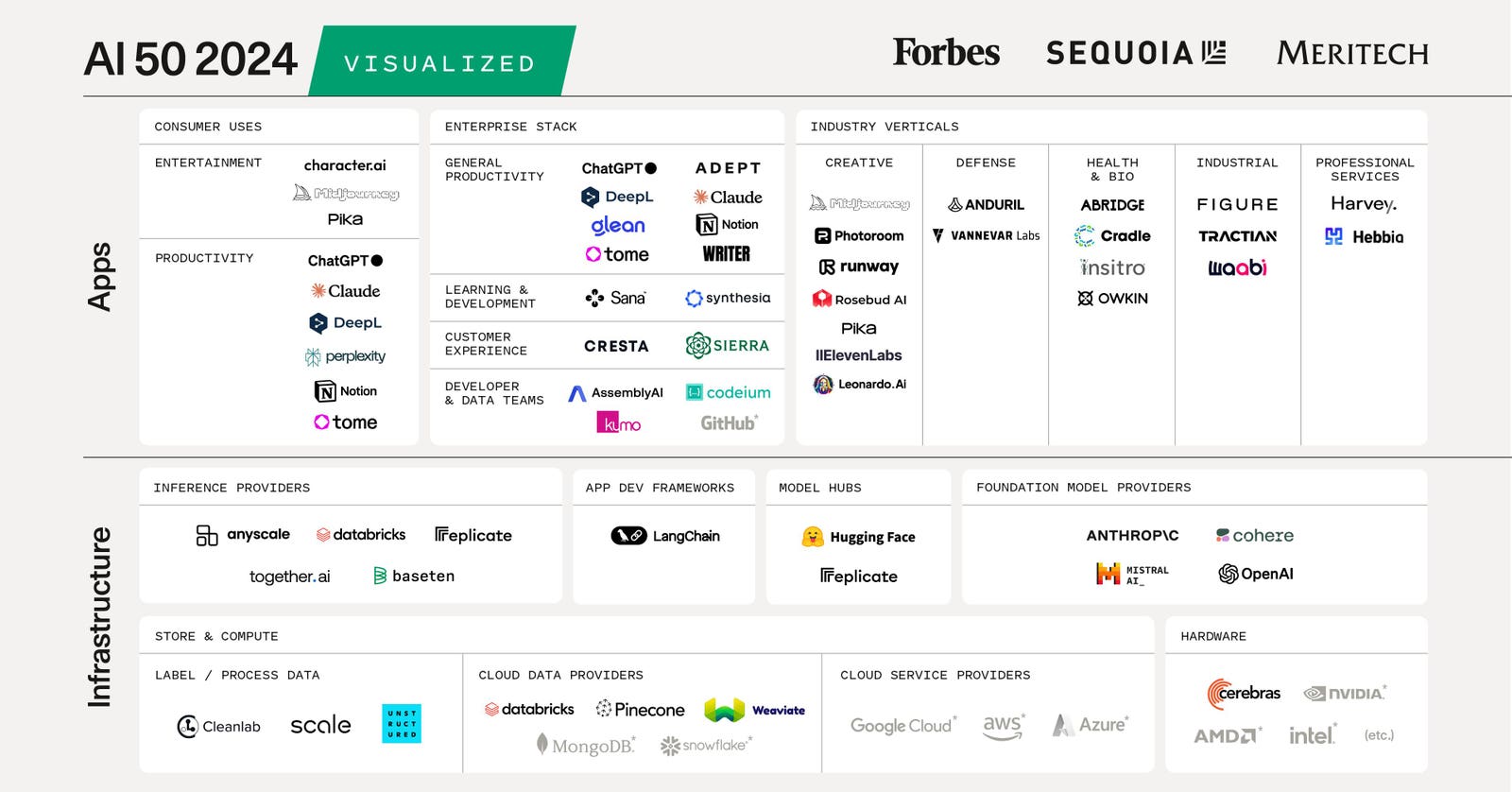
The AI 50 list for 2024 showcases the increasing impact of generative AI on enterprise and industry productivity, with a focus on AI-infused companies integrating AI into their processes to accelerate key performance indicators. The list also highlights the emergence of new industry sectors and the blurring lines between consumer and prosumer for creative software. As AI continues to evolve, it is expected to drive a productivity revolution, shaping the future of business and industry, and leading to the development of new tools for the next generation of companies. AI has the potential to reduce costs, increase productivity, and drive societal improvements, but responsible implementation and efforts to retrain and empower individuals will be crucial.
The development of AI agents, which are AI models with independent agency to pursue goals in the real world, could fundamentally change how we work. While current AI agents are not yet fully capable, future generations are expected to be much more advanced. However, the potential implications of creating AI agents that can reason and act independently raise concerns about liability, moral quandaries, and the risk of "rogue AI." Researchers are working on tests and regulatory policies to address these challenges before the widespread release of such agents.
Sam Altman, CEO of OpenAI, expressed dissatisfaction with GPT-4, stating that it "kind of sucks" relative to where it needs to be. He anticipates that the upcoming GPT-5 will show a significant improvement, as GPT-4 now seems less impressive compared to its predecessor, GPT-3. Altman uses GPT-4 as a brainstorming partner but believes that the current AI tools will appear inadequate in the future as technology advances on an exponential curve.
The recent events surrounding Sam Altman's firing and rehiring at OpenAI raise questions about the sustainability of the organization's fruitful contradiction - being a for-profit company overseen by a nonprofit board with a corporate culture somewhere in between. The field of AI is unique, combining academic research with the intensity and audacity of the startup world. The article explores the tensions between the scientist's desire to discover, the capitalist's drive to ship products, and the cautiousness of a regulatory agency. The future of AI remains uncertain, with diverging opinions on whether it will lead to positive or negative outcomes. The challenge for OpenAI lies in maintaining its culture and mission orientation as it grows, while also navigating the pressures of the industry.
OpenAI CEO Sam Altman may be considering a return to the company after his surprise firing. The board is reportedly having second thoughts and has asked Altman to come back. The decision to rehire Altman could have significant implications for the future of AI. The firing was the result of tensions between Altman, who favored aggressive AI development, and the board members who wanted a more cautious approach. Altman's firing was swift and unexpected, with even important partners like Microsoft being left in the dark. OpenAI has appointed Mira Murati as interim CEO while they search for a permanent replacement.