

The article discusses the scientific concept of the false vacuum, suggesting that our universe might be in a temporary, unstable energy state that could potentially lead to its sudden destruction through a process called vacuum decay, which challenges the assumption that the laws of nature are constant and reliable.
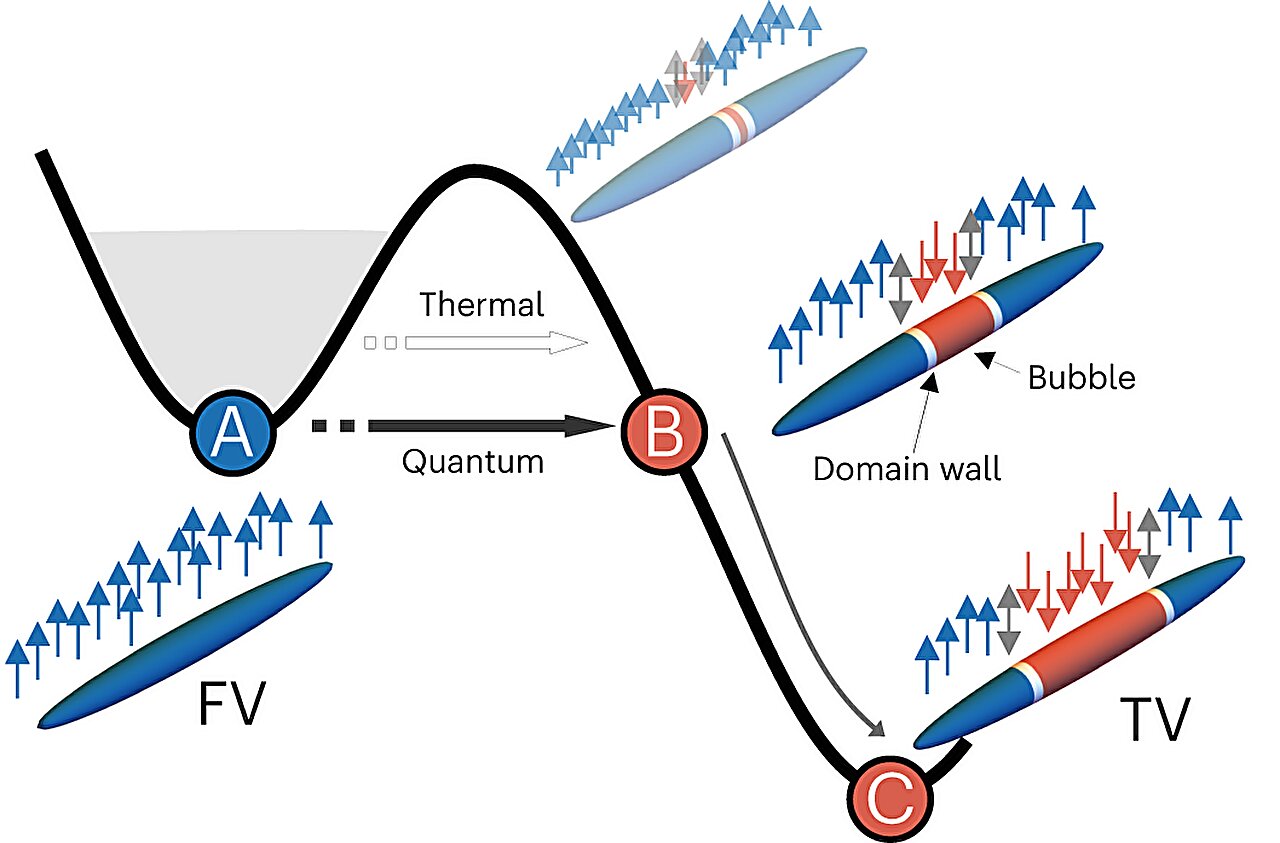
An international research team, with support from Newcastle University, has produced the first experimental evidence of vacuum decay, a phenomenon known as "false vacuum decay," in a carefully controlled atomic system. The experiment, conducted in Italy, observed the formation of bubbles through false vacuum decay in a quantum system, supported by theoretical simulations and numerical models. This groundbreaking research sheds light on the early universe and ferromagnetic quantum phase transitions, with the ultimate goal of exploring vacuum decay at absolute zero temperature driven purely by quantum vacuum fluctuations.