
Tag

Energy Dissipation

All articles tagged with #energy dissipation

science2 years ago

Unveiling Allosteric Regulation in LHCII: Cryo-EM Sheds Light on Energy Dissipation

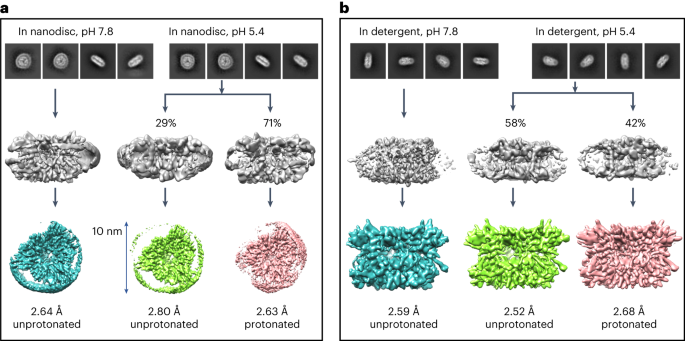
Cryo-EM structures of the major light-harvesting complex II (LHCII) in photo-active and photo-protecting states have been determined, revealing the allosteric regulation of light harvesting and excess energy dissipation in photosynthesis. The structures provide insights into the mechanisms of non-photochemical quenching and photoprotection in plants, highlighting the role of pH sensing and the PsbS protein. The data availability includes cryo-EM maps and structure models deposited in the Electron Microscopy Data Bank and Protein Data Bank, respectively. Understanding these regulatory processes could lead to improvements in plant photosynthesis and crop productivity.

science-and-technology2 years ago

Revolutionary Insights into Quantum Turbulence Unveiled.

Researchers from Lancaster University and Aalto University have demonstrated the dissipation of energy in quantum turbulence, providing insights into turbulence across various scales. The team's findings demonstrate a new understanding of how wave-like motion transfers energy from macroscopic to microscopic length scales, and their results confirm a theoretical prediction about how the energy is dissipated at small scales. The discovery could become a cornerstone of the physics of large quantum systems and could lead to improved engineering in domains where the flow and behaviour of fluids and gases like water and air is a key question.

physics2 years ago

Exploring Quantum Turbulence from the Basics

Researchers at Aalto University have studied turbulence in the Helium-3 isotope in a unique, rotating ultra-low temperature refrigerator and found that Kelvin waves act on individual vortices by continually pushing energy to smaller and smaller scales, ultimately leading to the scale at which dissipation of energy takes place. This new understanding of how wave-like motion transfers energy from macroscopic to microscopic length scales could lead to improved engineering in domains where the flow and behavior of fluids and gases like water and air is a key question.