At CES 2026, Intel announced the launch of the Core Ultra Series 3 processors, the first built on the advanced Intel 18A process, powering over 200 PC designs and certified for edge and industrial use cases, with significant performance and AI capabilities, available for pre-order in January 2026.
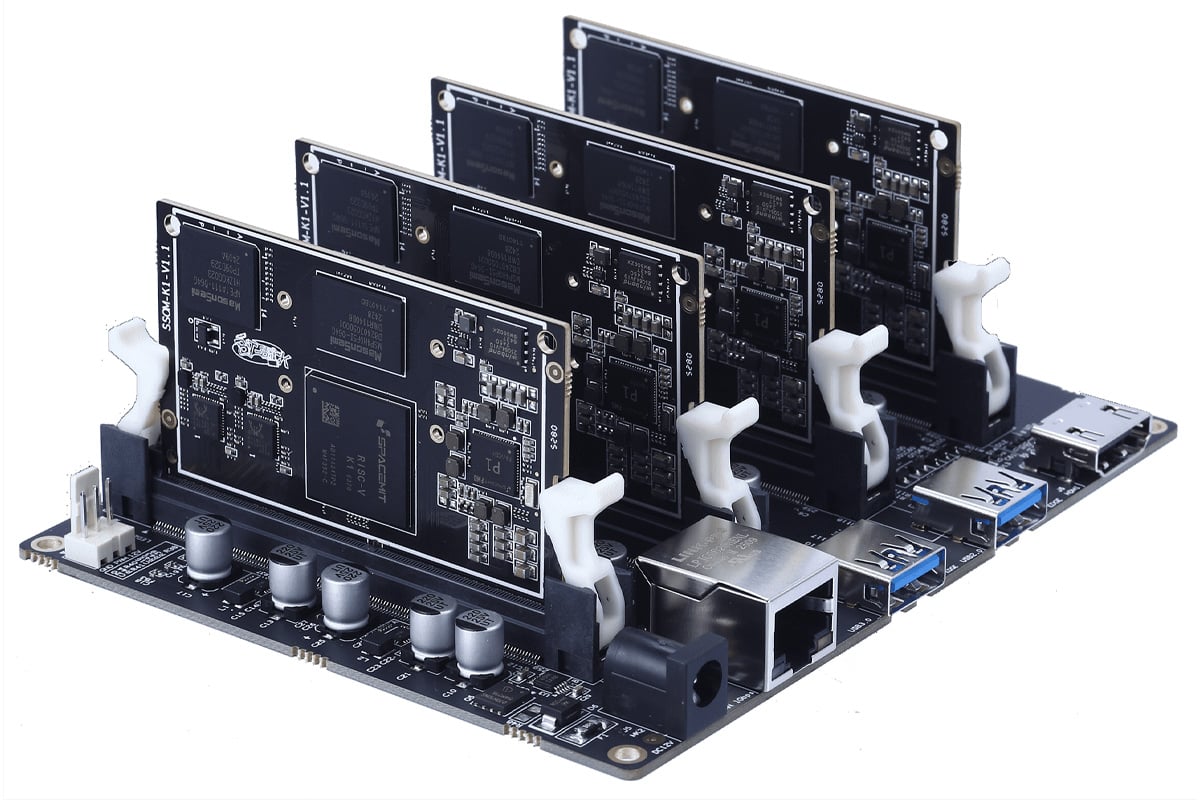
Bit-Brick Cluster K1 is a versatile 4-slot RISC-V cluster board designed for edge computing, AI, and embedded applications, supporting up to four SSOM-K1 modules with high-performance features, extensive I/O options, and software support for various operating systems, available for around $125 without modules.
Cisco has launched the Cisco Unified Edge platform, an integrated, modular system that extends data center capabilities to the edge, supporting real-time AI inferencing and agentic workloads across various industries with enhanced performance, security, and operational simplicity.
Cisco has introduced the Unified Edge, an all-in-one rack designed to enable local AI processing in retail, healthcare, and manufacturing settings, allowing for easier deployment and remote management of AI tasks at the edge of networks.
Originally Published 6 months ago — by Hacker News
A diverse group of developers and researchers are working on innovative projects including a decentralized resource allocation protocol called Rank, a mail-based subscription service for Cold War history, a 3D voxel game engine, an open-source Nest thermostat, and various AI and software tools, reflecting a vibrant community focused on advancing technology across multiple domains.
Qualcomm has established itself as a leader in mobile AI with its Snapdragon processors and Cloud AI100 Ultra, offering specialized hardware, energy efficiency, widespread adoption in mobile devices, and comprehensive AI software tools. The company's Snapdragon X Elite demonstrates impressive AI and CPU performance, outperforming competitors in benchmarks. Qualcomm's AI Hub provides developers with pre-optimized AI models and resources for on-device AI development, positioning the company to lead in edge AI hardware and software.
Intel has announced its new Edge Platform at MWC 2024, a modular, open software platform designed to simplify the development, deployment, and management of edge and AI applications at scale with cloud-like simplicity. The platform aims to address the growing need for edge computing and AI applications, offering capabilities such as infrastructure management, AI application development, and deep hardware awareness. Intel's Edge Platform has garnered support from industry leaders and aims to empower enterprises to build and manage edge-native AI applications across various industries.
Intel CEO, Pat Gelsinger, announced during the company's Q2 2023 earnings call that Intel plans to integrate AI into every product they build. Intel is set to release Meteor Lake, its first consumer chip with a built-in neural processor for machine learning tasks. Gelsinger emphasized the importance of AI at the client and edge level, stating that certain AI-enabled tasks cannot be efficiently performed in the cloud due to latency, bandwidth, and cost constraints. He highlighted the potential for AI integration in various sectors, including hearing aids, retail, manufacturing, and enterprise data centers. While Intel aims to establish its presence in the AI market, it recognizes the value of both cloud and client-centered AI solutions.
Providing internet connectivity on Mars is a challenge due to limited bandwidth and the distance between Earth and Mars. A proposed solution is to build a constellation of 81 satellites around Mars for edge computing, allowing data to be locally accessible and distributed across servers for redundancy. The system could be built in stages, with a few satellites accompanying exploratory missions and the full constellation in place by the time long-term stations are established.