The article discusses the impact of tariff uncertainties on the market in 2025 and highlights top summer stocks like Carnival, Anheuser-Busch, and Uber, which are resilient and show strong seasonal performance and fundamentals, making them attractive investments amid geopolitical and economic volatility.
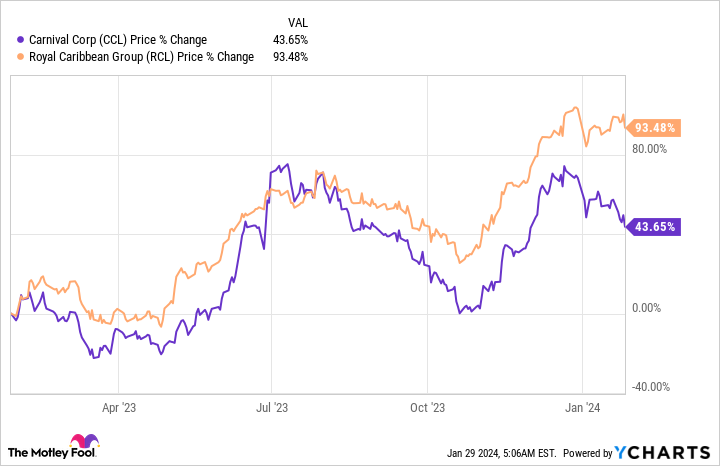
Carnival Corporation, parent company of Carnival Cruise Line, has seen its stock lag behind peers due to a troubled balance sheet with high debt levels. While the company has made progress in strengthening its debt profile, it still lags behind competitors in reducing leverage. Carnival aims to substantially increase free cash flow in 2024 and beyond to drive down its debt balances, but caution is advised for investors due to the company's ongoing financial challenges and the potential impact of a recession on cruise spending.
Carnival Corporation is rerouting 12 cruise ships across seven brands away from the Red Sea through May 2024, with an expected adjusted earnings per share impact of $0.07 to $0.08 for full year 2024, primarily in the second quarter. Despite this change, the company has not observed any impact on booking trends and does not have any other Red Sea transits scheduled until November 2024.
Carnival Corporation reported better-than-expected fourth-quarter results, with strong ongoing vacation booking trends and "record demand" persisting post-pandemic. CEO Josh Weinstein attributes this to increased advertising and onboard investments, driving "true organic demand" beyond pent-up post-COVID travel appetite. The company's world-class brand experience and delivery of memorable voyages are attracting first-time and loyal cruisers, resulting in historic volumes and pricing power.
Carnival Corporation is expected to benefit from robust passenger ticket revenues in its upcoming Q4 earnings report. The company has shown strong performance in the past year, with its stock outperforming the industry. The anticipated improved performance is driven by heightened booking activities, a favorable pricing environment, and successful capacity-generation initiatives. Strong demand and improved onboard spending are also expected to contribute to the company's financial results. Revenues from various regions are predicted to increase significantly. The Zacks Consensus Estimate for Q4 earnings is a loss of 12 cents per share, with revenues expected to jump 38.6% year-over-year.
Carnival Corporation & plc's share price has surged by 28% in the last month, capping off a 121% increase in the past year. Despite this, the company's price-to-sales (P/S) ratio of 1.2x is still relatively moderate compared to the industry median of 1.4x. While Carnival Corporation has shown strong revenue growth, investors may be concerned that this growth could slow down in the future. Analysts forecast a lower revenue growth rate of 8.7% per year for the next three years, compared to the industry's 13% growth forecast. The current P/S ratio suggests that investors are willing to pay a premium for exposure to the stock, but the limited growth expectations may eventually weigh down the shares.
Carnival Corporation is set to report its Q4 fiscal 2023 earnings on December 21, 2023. Analysts expect the company to show year-over-year revenue growth driven by improved booking trends and a strong pricing landscape. However, high costs are expected to impact the company's bottom line. Carnival's adjusted EBITDA for the quarter is projected to be between $800 million and $900 million, with an estimated adjusted loss per share between 18 cents and 10 cents. The Zacks model does not predict an earnings beat for Carnival this time around.
Carnival Corporation, the cruise line operator, reported record revenue and its first quarterly profit since 2020, driven by a surge in bookings amid the post-pandemic travel boom. The company's net income of $1.07 billion exceeded expectations, while revenue surged almost 60% from a year ago. However, Carnival issued weaker-than-expected guidance for the fourth quarter, citing concerns about rising fuel costs impacting profit margins. Despite the profit outlook, management remains confident in the strong demand for cruise bookings and expects the momentum to continue into next year.
Carnival Corporation & plc plans to pre-pay $1.2 billion of debt and initiate a refinancing transaction. The company intends to raise $1.0 billion through a new senior secured first lien term loan and an additional $500 million of secured debt. The proceeds will be used to repay a portion of the company's existing term loan facility. After the refinancing, Carnival plans to redeem $1.2 billion of its highest-cost debt, resulting in annual interest expense savings of over $120 million. The company expects its year-end debt balance to be less than $32.0 billion.
Carnival Corporation (CCL) shares are trading higher on Tuesday as the stock rebounds from a fall on Monday following the company's second-quarter earnings report. Multiple analysts have raised their price targets for Carnival, with Wells Fargo, Morgan Stanley, Susquehanna, and Citigroup all increasing their price targets on the stock.
Carnival Corporation reported record future bookings in the first quarter, with demand rebounding from the COVID-19 pandemic. The company's European segment saw its booking curve continue to be more than 80% recovered compared to pre-COVID 2019 levels, while the North America and Australia segment mirrored peak 2019 levels. Carnival expressed optimism about the improving demand environment for sailings, with bookings on Black Friday and Cyber Monday being very strong. The company's cumulative advanced booked position for the remainder of 2023 is at higher ticket prices in constant currency, normalized for future cruise credits, as compared to strong 2019 prices.
Carnival Corporation beats Q1 earnings expectations with a $0.55 per share loss on $4.43B in revenue and adjusted EBITDA of $382M. The company credits strong demand, bundled package offerings, and pre-cruise sales for the record performance. However, below-consensus EPS and EBITDA forecasts for the full year overshadowed the quarterly performance, leading to a choppy course for Carnival's stock in Monday's trading. The company expects adjusted EBITDA of $3.9B to $4.1B for the full year, with sequential improvement expected through the year.