
"Insights into the Ecology and Diet of 45,000-Year-Old Homo sapiens in Central Europe"
TL;DR Summary
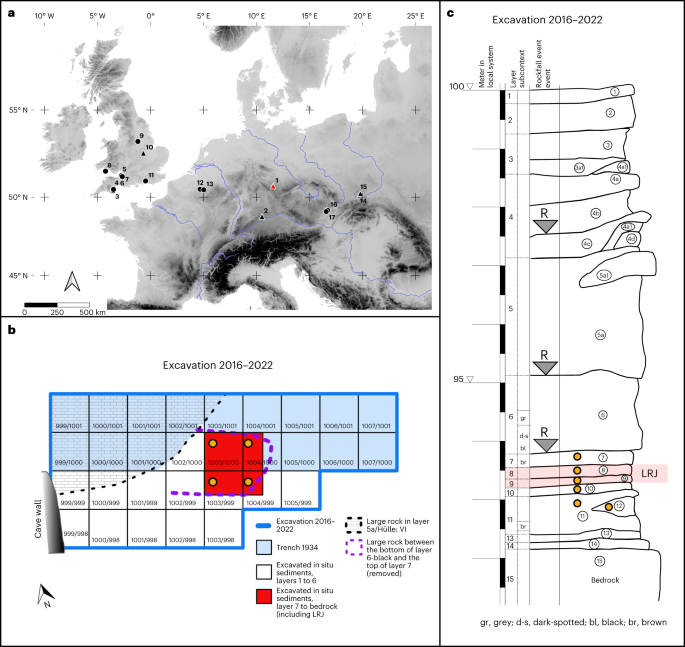
Recent excavations at Ranis, Germany, have revealed the presence of early Homo sapiens in Europe around 45,000 years ago. The faunal assemblages indicate a cold climatic environment with a predominance of large terrestrial mammals in the human diet. The study integrates zooarchaeology, palaeoproteomics, sediment DNA, and stable isotopes to reconstruct the ecology, subsistence, and diet of these early humans, suggesting their expedient visits in small, mobile groups. The findings shed light on the behavioral adaptations and survival strategies of early Homo sapiens populations during their expansion into Northern European Plains.
- The ecology, subsistence and diet of ~45000-year-old Homo sapiens at Ilsenhöhle in Ranis, Germany Nature.com
- What a 45,000-year-old pit of bones reveals about our earliest human ancestors NBC News
- 45000-year-old bones unearthed in cave are oldest modern-human remains in Central Europe Livescience.com
- Neanderthals and humans lived side by side in Northern Europe 45,000 years ago, genetic analysis finds Phys.org
- Homo sapiens reached the higher latitudes of Europe by 45,000 years ago Nature.com
Reading Insights
Total Reads
0
Unique Readers
1
Time Saved
60 min
vs 61 min read
Condensed
99%
12,040 → 90 words
Want the full story? Read the original article
Read on Nature.com