
Webb Telescope captures turbulent weather on distant exoplanet.
TL;DR Summary
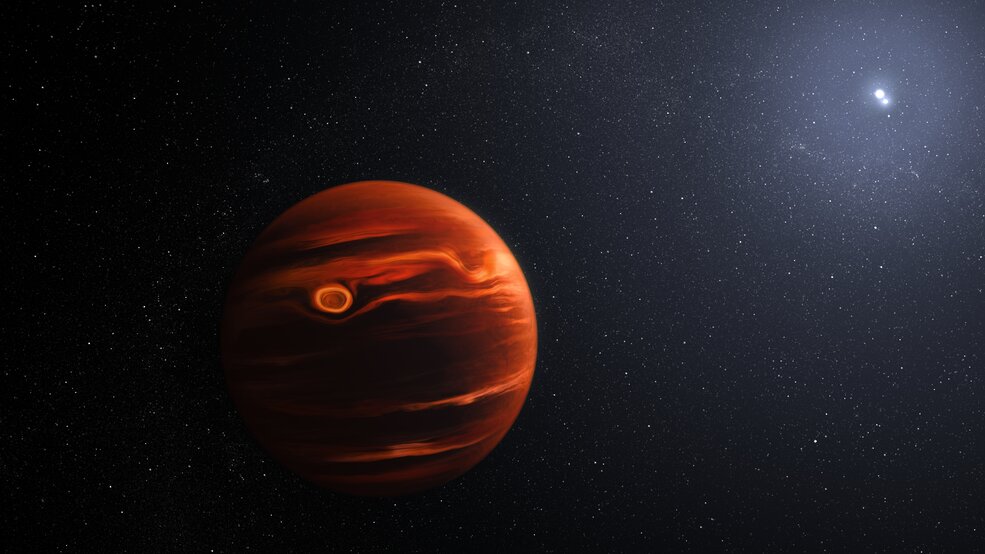
The James Webb Space Telescope has detected silicate cloud features in the atmosphere of exoplanet VHS 1256 b, which is about 40 light-years away and orbits two stars. The planet's atmosphere is constantly rising, mixing, and moving during its 22-hour day, resulting in dramatic brightness changes. The team also detected water, methane, carbon monoxide, and carbon dioxide, making it the largest number of molecules ever identified on a planet outside our solar system. The researchers used two spectrographs aboard Webb to observe the planet's near- to mid-infrared light emitted and identified silicate clouds, water, methane, and carbon monoxide.
Topics:top-news#astronomy#exoplanet#james-webb-space-telescope#silicate-clouds#spectrographs#vhs-1256-b
- James Webb spots swirling, gritty clouds on remote planet Phys.org
- Webb telescope details weather patterns on a distant planet with two suns CNN
- Webb Telescope detects 'turbulent' clouds on huge exoplanet that orbits 2 stars VideoFromSpace
- The Webb Telescope Is So Powerful, It Spotted a Dust Storm on a Planet in a Different Star System Futurism
- NASA's Webb Spots Swirling, Gritty Clouds on Remote Planet WebbTelescope.org
Reading Insights
Total Reads
0
Unique Readers
8
Time Saved
4 min
vs 5 min read
Condensed
90%
979 → 98 words
Want the full story? Read the original article
Read on Phys.org