
"Unlocking the Secrets of the Universe: Exploring Alternate Cosmology in a Lab"
TL;DR Summary
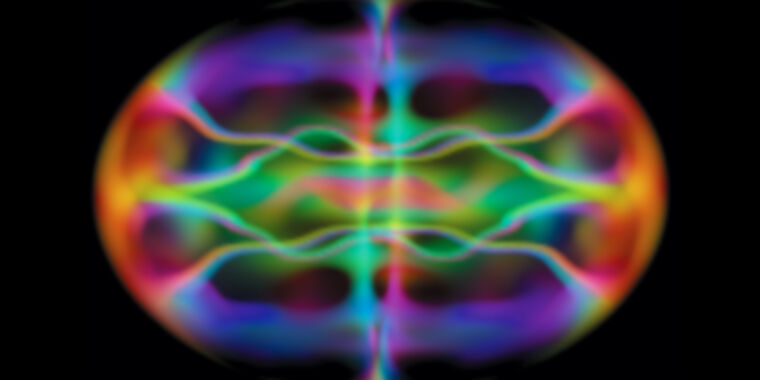
Researchers in Germany have created a tabletop quantum field simulation to explore possible features of the early Universe shortly after the Big Bang. By using magnets and lasers to control a sample of potassium-39 atoms held close to absolute zero, they were able to simulate a Universe with different curvatures. The experiment involved trapping the atoms in a two-dimensional layer and cooling them to a quantum-mechanical state known as a Bose-Einstein condensate. The results showed that it is possible to simulate spatially curved and expanding spacetimes, providing insights into the behavior of the early Universe.
Reading Insights
Total Reads
0
Unique Readers
0
Time Saved
3 min
vs 4 min read
Condensed
87%
758 → 95 words
Want the full story? Read the original article
Read on Ars Technica