
"Efficient CO2 Electroreduction System for Emissions Reduction"
TL;DR Summary
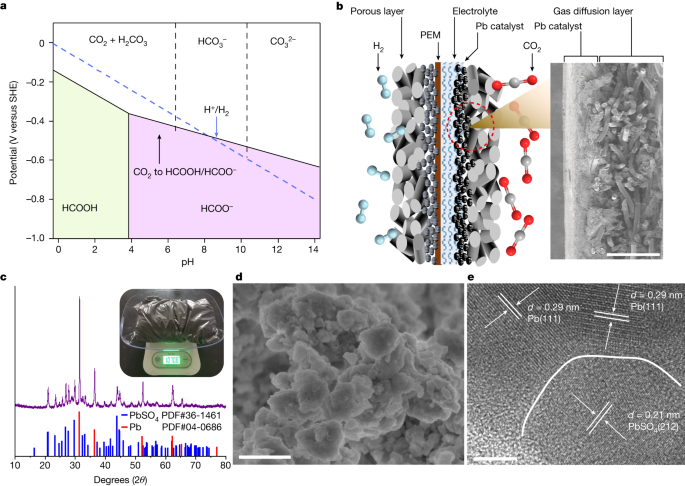
Researchers have developed a proton-exchange membrane system that efficiently reduces carbon dioxide (CO2) to formic acid using a catalyst derived from waste lead-acid batteries, achieving over 93% Faradaic efficiency when coupled with hydrogen oxidation. The system demonstrates nearly 91% single-pass conversion efficiency for CO2 at a current density of 600 mA cm−2 and cell voltage of 2.2 V, and has been shown to operate continuously for more than 5,200 h, offering a promising advancement in the development of carbon-neutral technologies.
Topics:science#carbon-neutral-technologies#catalyst#co2-conversion#formic-acid#proton-exchange-membrane-system#science-and-technology
- Durable CO2 conversion in the proton-exchange membrane system Nature.com
- PolyU develops high-efficiency carbon dioxide EurekAlert
- New carbon dioxide electroreduction system developed to reduce CO2 emissions Innovation News Network
Reading Insights
Total Reads
0
Unique Readers
6
Time Saved
14 min
vs 15 min read
Condensed
97%
2,828 → 76 words
Want the full story? Read the original article
Read on Nature.com