
"The Genetic Mystery of Human Tail Loss Unraveled"
TL;DR Summary
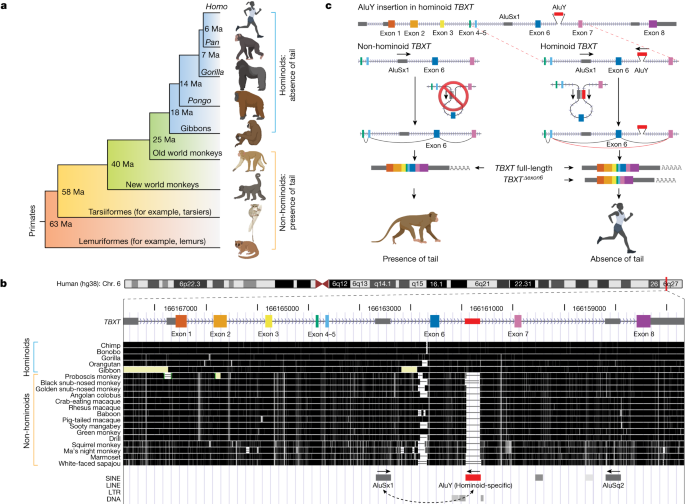
The genetic basis of tail-loss evolution in humans and apes is explored, with a focus on the role of Alu elements in the TBXT gene. The study identifies a hominoid-specific intronic AluY element in TBXT that induces alternative splicing, leading to the production of a TBXTΔexon6 isoform. This isoform is found to be associated with tail loss, as evidenced by experiments in human ES cells and mouse models. The findings provide insights into the genetic mechanism underlying the loss of the tail in hominoids and its potential link to human traits such as bipedalism.
- On the genetic basis of tail-loss evolution in humans and apes Nature.com
- We finally know why humans don't have tails Livescience.com
- A genetic parasite may explain why humans and other apes lack tails Science News Magazine
- How Humans Lost Their Tails Scientific American
Reading Insights
Total Reads
0
Unique Readers
6
Time Saved
59 min
vs 60 min read
Condensed
99%
11,968 → 94 words
Want the full story? Read the original article
Read on Nature.com