
"NASA's Hubble Discovers Celestial 'String of Pearls' in Galactic Collisions"
TL;DR Summary
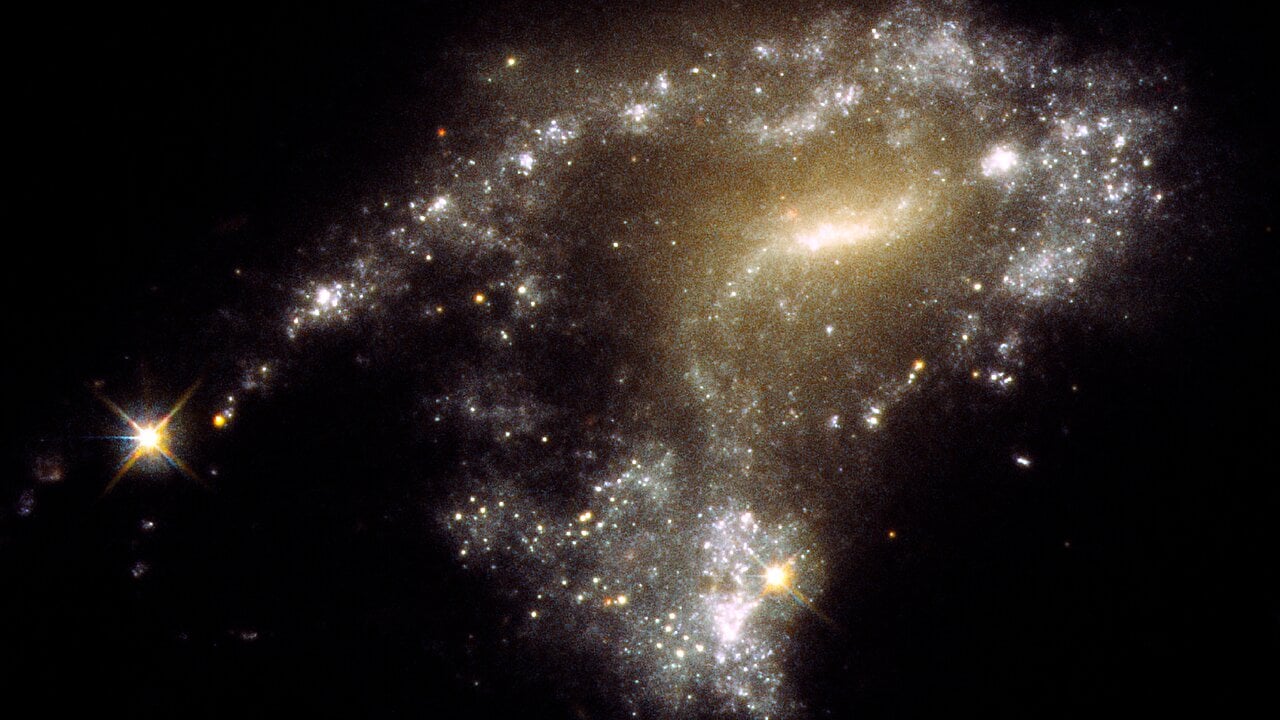
The Hubble Space Telescope has detected "string of pearls" star clusters in the tidal tails of 12 interacting galaxies, each containing about 1 million newborn stars per cluster. These clusters, formed as a result of gravitational forces during galaxy collisions, are very young, only 10 million years old, and are stretching for thousands of light-years. The discovery sheds light on the formation of stars and provides insight into the processes that regulate star formation, offering a glimpse into the distant past and the potential for new generations of stars to exist.
- Hubble detects celestial 'string of pearls' star clusters in galaxy collisions Phys.org
- Hubble Space Telescope tells a starry 'tail' of 12 mingling galaxies Space.com
- NASA's Hubble Traces 'String of Pearls' Star Clusters in Galaxy Collisions Science@NASA
- Hubble Finds Clusters of Newborn Stars in Tidal Tails of Merging Galaxy Systems Sci.News
- NASA's Hubble space telescope reveals a galactic 'string of pearls' Popular Science
Reading Insights
Total Reads
0
Unique Readers
7
Time Saved
4 min
vs 5 min read
Condensed
89%
828 → 91 words
Want the full story? Read the original article
Read on Phys.org