
Hubble Telescope Captures Stunning Views of Cosmic Explosions and Distant Galaxies.
TL;DR Summary
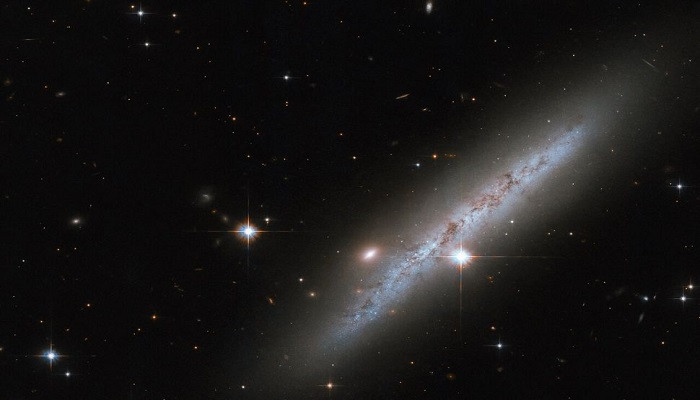
The Hubble Space Telescope has captured the aftermath of a supernova explosion that occurred 30 million years ago in the UGC 2890 galaxy, which is 30 million light-years away from Earth in the constellation Camelopardalis. Astronomers recorded the magnitude of the supernova to be -17.37, which was one of the brightest so far. Fourteen years after the supernova explosion, Hubble has looked at the remains of this violent cosmic event. The ACS instrument is able to see deep sky objects in a wide range of wavelengths from ultraviolet all the way to near-infrared, and shows the UGC 2890 galaxy to be blue with "threads of dark red dust" sprinkled throughout.
- Hubble space telescope explores aftermath of 30m-year-old cosmic explosion Geo News
- Hubble captures amazing view of spiral galaxy that is 30 million light-years away VideoFromSpace
- Spectacular Hubble Image Captures Aftermath of Catastrophic Supernova Explosion SciTechDaily
- Hubble Telescope eyes aftermath of supernova in distant galaxy (video) Space.com
- View Full Coverage on Google News
Reading Insights
Total Reads
0
Unique Readers
6
Time Saved
1 min
vs 2 min read
Condensed
71%
384 → 110 words
Want the full story? Read the original article
Read on Geo News