
"Discovery of Dual Quasar Sheds Light on Black Hole Collision in Galaxy Merger"
TL;DR Summary
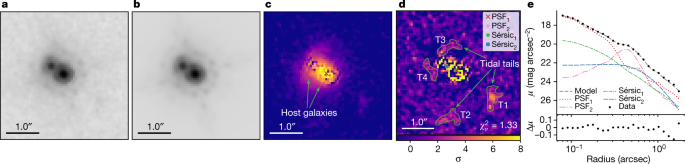
Astronomers have discovered a pair of quasars in a disk-disk galaxy merger at a redshift of 2.17, making it one of the closest quasar pairs ever found. The discovery was made using data from the Hubble Space Telescope, Chandra X-ray Observatory, and other telescopes. The quasar pair is believed to be a binary system, rather than a gravitational lens, and could provide insights into the co-evolution of supermassive black holes and their host galaxies.
- A close quasar pair in a disk–disk galaxy merger at z = 2.17 Nature.com
- Unexpected Double Quasar Discovered – Pair of Merging Galaxies Ignite Black Holes on a Collision Course SciTechDaily
- What is a quasar? Definition and first quasar discovered BBC Sky at Night Magazine
- Hubble Unexpectedly Finds Double Quasar in Distant Universe NASA
- A dual quasar shines light on two supermassive black holes on a collision course inside a galaxy merger Phys.org
- View Full Coverage on Google News
Reading Insights
Total Reads
0
Unique Readers
0
Time Saved
10 min
vs 10 min read
Condensed
96%
1,988 → 74 words
Want the full story? Read the original article
Read on Nature.com