Anthropic plans to invest $50 billion in building AI-specific data centers across the US, including Texas and New York, to support AI development, create jobs, and strengthen American AI leadership, marking its first major direct data center project.
The Trump administration has delayed implementing 100% tariffs on pharmaceuticals, which were initially threatened to start immediately, signaling a shift towards encouraging voluntary commitments from drug companies to invest in U.S. infrastructure and negotiate drug prices.
Chinese hackers are reportedly embedding themselves in U.S. critical infrastructure to gain an advantage in potential conflicts, according to Morgan Adamski of U.S. Cyber Command. This follows a significant cyberespionage operation, "Salt Typhoon," which targeted U.S. telecommunications, compromising call records and communications of key officials. The Chinese government denies involvement, and the Chinese Embassy has not commented on the allegations.
Chinese government hackers, known as Salt Typhoon, have deeply infiltrated U.S. telecommunications infrastructure, allowing them to intercept phone calls and text messages, though encrypted communications remain secure. This breach, described as the worst telecom hack in U.S. history, has affected major carriers like AT&T, Verizon, and T-Mobile, with the hackers still embedded in the system. The breach, which is not election-related, has primarily targeted individuals in Washington D.C., raising concerns about political espionage. The U.S. faces significant challenges in removing the hackers without overhauling outdated telecom equipment.
FBI director Christopher Wray warned at the Munich security conference that China's cyber attacks on US critical infrastructure have reached a scale greater than previously seen, posing a significant threat to national security. The Chinese hacking network, Volt Typhoon, has infiltrated more than 20 major US suppliers, including a water utility in Hawaii and a West Coast port, bypassing cybersecurity systems and leaving strategic vulnerabilities. Analysts believe China has shifted its cyber strategy from intelligence-gathering to infiltration, with a focus on pre-positioning offensive weapons within critical infrastructure for potential disruption or destruction in the event of a conflict.
US and allied intelligence agencies have revealed that a sophisticated group of Chinese hackers, known as Volt Typhoon, has been targeting critical US infrastructure including aviation, rail, mass transit, highway, maritime, pipeline, water, and sewage systems for as long as five years. The group has been observed maintaining access within some victim IT environments, raising concerns about potential sabotage rather than espionage. The US government has sought assistance from private technology industry to track and counter this malicious cyber activity.
Chinese hacking groups had undetected access to US infrastructure systems for at least five years, targeting sectors such as communications, energy, transportation, and waste and wastewater. The Joint Cybersecurity Advisery, comprising US and allied security groups, expressed concerns about potential disruptive effects in the event of geopolitical tensions or conflicts. FBI Director Christopher Wray emphasized the threat posed by Chinese hackers to critical infrastructure, urging increased attention and action from lawmakers.
U.S. federal agencies and allied cybersecurity and intelligence agencies have warned that Chinese hackers have been secretly embedded in U.S. infrastructure for up to five years, with the potential to conduct a destructive cyberattack in the event of a major conflict. The hackers have targeted key infrastructure sectors and have operated stealthily, raising concerns about their potential to cause real-world harm. China denies the allegations, but U.S. officials are increasingly vocal about the threat posed by these hackers.
Chinese hackers have reportedly had access to some US infrastructure systems for at least five years, with the potential to disrupt water and electricity. US intelligence officials have raised concerns about the hackers being used to disrupt a US response if China invades Taiwan. A nearly 50-page report by US and allied security agencies details the hackers' stealthy techniques and aims to help private owners of critical infrastructure spot their presence. The report also reveals that the hackers have breached computer networks at energy, transportation, and water facilities in the US and its overseas territories, sparking a monthslong effort by US national security officials to remove them.
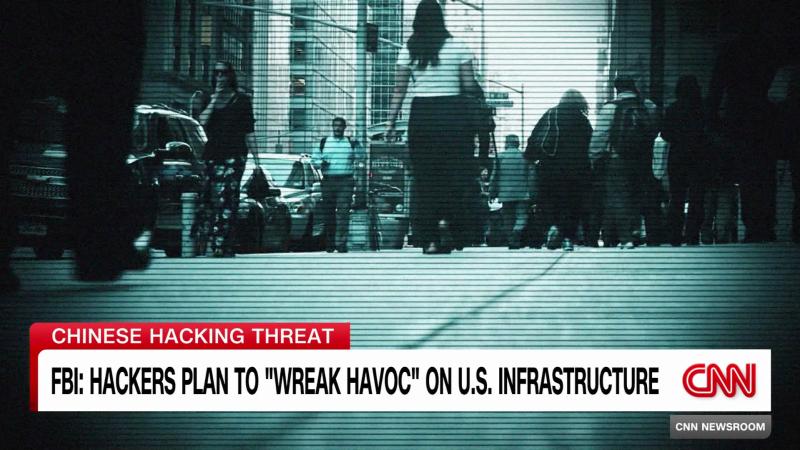
The FBI has issued a warning about the threat posed by Chinese hackers to critical U.S. infrastructure, with FBI Director Christopher Wray emphasizing the potential for these hackers to "wreak havoc." This marks Wray's most direct public warning to date about the cybersecurity threat from China.
A report reveals that state-sponsored Chinese hackers may have breached more than two dozen US systems, targeting critical infrastructure such as water utilities, ports, and oil and gas pipelines. Experts believe this is part of China's long-term strategy to distract or infect American commerce and infrastructure in the event of a conflict over Taiwan. The hackers aim to infiltrate systems unnoticed, gather information, and launch ransomware attacks at vulnerable moments. The US is currently lagging behind in cybersecurity and faces the challenge of catching up to China's hacking capabilities.
Chinese-affiliated hacking groups have infiltrated critical American infrastructure, including a water utility in Hawaii, a major West Coast port, and an oil and gas pipeline. By targeting careless office workers, these hackers have bypassed cybersecurity systems and gained access to strategic vulnerabilities. The project, codenamed Volt Typhoon, aims to position China to disrupt or destroy critical infrastructure in the event of a conflict. The focus on Guam is particularly concerning, as it is a key military base in the Pacific. The US must take action to protect its critical infrastructure from these cyber threats.
Steve Eisman, the legendary investor who predicted the 2008 housing market crash, is betting big on US infrastructure and greenification initiatives, citing the need for significant investments in the electrical grid. He has already seen success with utility stock Quanta Services, which has climbed around 34% since the start of 2021. While he acknowledges that tech stocks are investible for a long time, he believes there are other investment opportunities worth exploring beyond the hype around the sector.
China may be preparing for conflict after Microsoft warned of potential cyber attacks on US critical infrastructure by Chinese state-sponsored actor Volt Typhoon. Policy expert Jonathan D.T. Ward said the group likely targeted a wide range of critical infrastructure, including communications, manufacturing, utilities, transportation, construction, maritime government, information technology and education sectors. The US Cybersecurity & Infrastructure Security Agency and international cybersecurity authorities issued a joint Cybersecurity Advisory warning that Volt Typhoon could apply the same techniques against infrastructure networks across the US and other sectors worldwide. China's main objective remains to restructure the global economy with the PRC in the center.