
"Revolutionizing Two-Dimensional Solids: Active Particles Break Barriers"
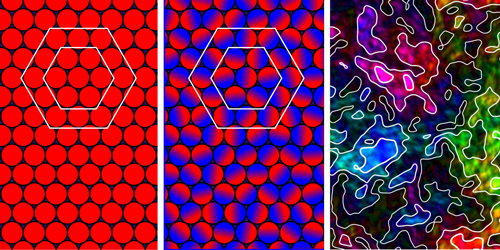
Active particles can form two-dimensional solids with long-range crystalline order and giant spontaneous deformations, which differ from those formed by nonmotile particles. These active systems exhibit quasi-long-range positional order and true long-range orientational order, similar to equilibrium solids. The power-law exponents describing the positional order in active systems cover a wide range, reaching values as high as 20. Understanding the interplay between order and fluctuations in active solids is crucial for integrating active elements into materials and fabrication processes.