
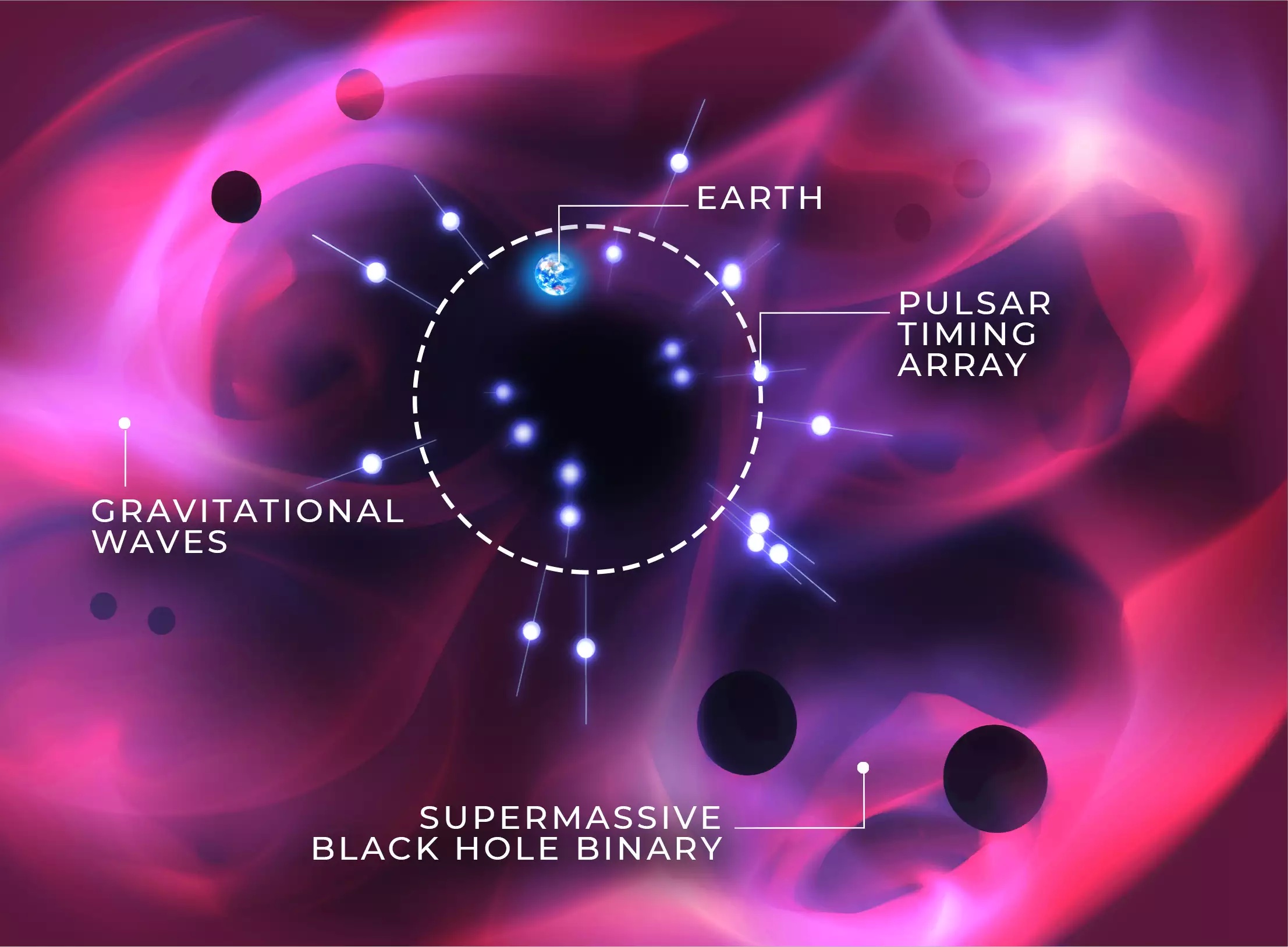
Pulsars: Unveiling Cosmic Dark Age with Gravitational Waves
Astronomers are exploring the use of pulsars as a telescope to detect gravitational waves. Pulsars, rotating neutron stars that emit regular radio pulses, can be used as cosmic timepieces. When a gravitational wave passes through a pulsar, its pulses shift slightly, but these shifts are at the random fluctuation level. By observing an array of pulsars, researchers can measure the statistical fluctuations and pinpoint the sources of background gravitational waves. Precise distance measurements of the pulsars in the array could be obtained through observatories like the Very Long Baseline Array, allowing for triangulation of the source. This method could help determine if the background waves come from supermassive binary black holes or other unknown sources.