
Tag

Structural Coloration

All articles tagged with #structural coloration

science-and-technology2 years ago

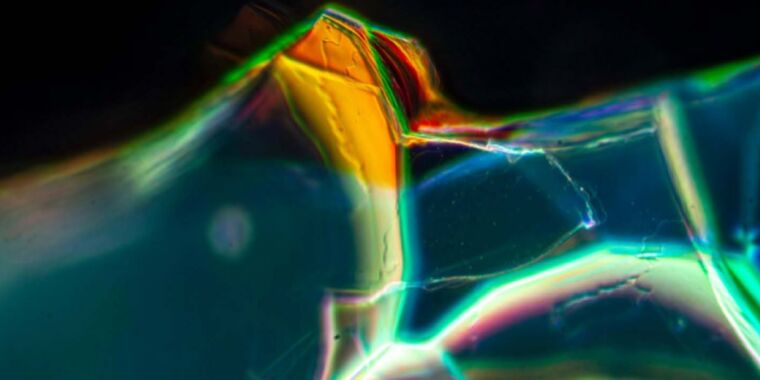
Centuries-old Roman "wow glass" reveals stunning photonic crystal patina

A shard of ancient Roman glass, known as the "wow glass," has been found to possess a rare golden-hued patina with unique optical properties. The patina is the result of the corrosion process slowly restructuring the glass to form photonic crystals, which create iridescent colors. Photonic crystals are tunable materials that can block certain wavelengths of light while allowing others to pass through. Scientists are studying natural structural coloration to develop commercial applications, such as plant-based films that cool when exposed to sunlight and chameleon-like films that change color when stretched. The shard was discovered near the ancient city of Aquileia, Italy, which was once a thriving center for trade and glass processing.

science-and-technology2 years ago

Lightweight and Colorful Paint Made with Colorless Nanoparticles.

Researchers from the University of Central Florida have developed "plasmonic paint," a lightweight, eco-friendly material that has the potential to replace most colored coatings. The paint is composed of two colorless materials: aluminum nanoparticles and aluminum oxide nanostructures, which can manipulate visible light and create any color, giving rise to the world's first full-color structural paint. The plasmonic paint is more durable than standard paint and can reduce the overall weight of objects, which is critically beneficial for the aerospace industry.

science2 years ago

Human Cells Engineered with Squid Camouflage.

Scientists have engineered human cells to replicate the camouflage ability of squids. The researchers focused on leucophores, skin cells that facilitate structural coloration through proteins called reflectins. By introducing reflectin-forming genes from squids into human cells and adding salt to the media of the cell cultures, the reflectin in the human cells began to clump together into larger nanoparticles, allowing them to tune the transparency by controlling the amount of salt. The goal is to better image squid skin cells, which could lead to more squid-inspired innovations like liquid windows.