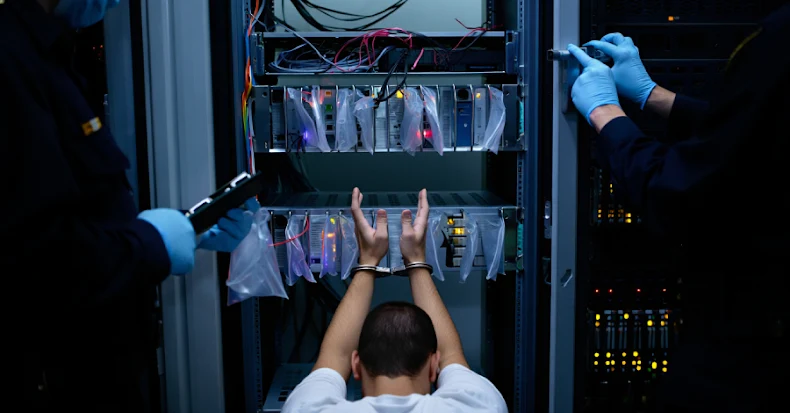
Two cybersecurity professionals pleaded guilty to running ransomware attacks using their skills to extort victims, including a medical device company that paid $1.2 million, with plans for sentencing in March. They were involved with the ALPHV BlackCat ransomware group, known for major attacks like on Change Healthcare, and face potential 20-year sentences.
Two U.S. cybersecurity professionals, Ryan Goldberg and Kevin Martin, pleaded guilty to conspiring with the ransomware gang ALPHV Blackcat to extort American companies, facing up to 20 years in prison, highlighting concerns about insider threats in the digital protection industry.
Hackers exploit the holiday season when security teams are reduced and companies are less vigilant, leading to a spike in cyberattacks like ransomware and phishing, with many high-profile incidents occurring during this period. Security teams prepare months in advance, and AI tools are suggested to help mitigate burnout and improve defenses during this vulnerable time.
INTERPOL's Operation Sentinel led to the arrest of 574 suspects across 19 African countries, recovering $3 million and dismantling cybercrime networks involved in BEC, digital extortion, and ransomware, with estimated losses over $21 million. Additionally, a Ukrainian national pleaded guilty in the U.S. for Nefilim ransomware activities, highlighting ongoing international cybercrime efforts.
Cybersecurity researchers discovered a vibe-coded malicious VS Code extension with built-in ransomware capabilities, which exfiltrates and encrypts files, and uses GitHub as a command-and-control server. Additionally, 17 npm packages disguised as SDKs were found to stealthily deploy Vidar Stealer, highlighting ongoing supply chain threats in open-source ecosystems. Microsoft has removed the malicious extension from the marketplace, emphasizing the importance of vigilance in software development.
A malicious VS Code extension named susvsex, created with AI assistance and advertising ransomware capabilities, was published on Microsoft's marketplace. Despite being reported for its malicious functions, Microsoft did not remove it. The extension encrypts files and exfiltrates data to a remote server, and uses hardcoded credentials to communicate with a command-and-control server. The incident raises concerns about vetting processes for extensions and the potential misuse of AI in malicious software development.
Microsoft warns Windows 10 users about security vulnerabilities due to unsupported systems, highlighting the high risk of ransomware and malware attacks, and advises upgrading to Windows 11 or strengthening interim protections like security software and backups to mitigate risks.
Volkswagen is suspected to have been targeted by the ransomware group 8Base, which claims to have stolen and leaked sensitive data, including employee and financial information, though the company states its core IT remains unaffected. The incident highlights ongoing cybersecurity threats to major industries and the importance of third-party risk management.
Asahi, Japan's largest brewer, was hit by a ransomware attack that disrupted operations and potentially led to the theft of personal data. The company is investigating the extent of the breach, working with cybersecurity experts, and has temporarily delayed its financial reporting. The attack was claimed by the Russia-based group Qilin, highlighting the increasing frequency of major cyber-attacks on global companies.
Japan's most popular beer, Asahi Super Dry, faces a potential shortage due to a ransomware cyberattack that disrupted the company's systems, leading to suspended operations and a possible nationwide supply shortage.
Google has introduced an AI-based feature in Drive for desktop to detect and stop ransomware attacks early, but its effectiveness has limitations against evolving threats and data leak tactics.
The UK’s National Crime Agency arrested a man in connection with a ransomware attack that caused widespread flight delays across Europe by targeting airport software, with the suspect released on conditional bail as investigations continue.
A ransomware attack on Collins Aerospace caused major disruptions at several European airports, including Heathrow, Brussels, and Berlin, leading to flight delays and cancellations, with authorities investigating the incident and working to restore systems.
A ransomware attack on Collins Aerospace's passenger processing system caused widespread airport disruptions across Europe, including delays and cancellations, with the EU's cybersecurity agency ENISA confirming the incident but not revealing further details.
The EU's cybersecurity agency confirmed that ransomware caused ongoing disruptions at major European airports, including Heathrow, Berlin Brandenburg, Brussels, Dublin, and Cork, due to a cyberattack on Collins Aerospace's check-in systems. Airports are operating manually and advising passengers to check flight statuses, with some flights canceled or delayed. The attack has led to significant travel chaos across Europe and North America.