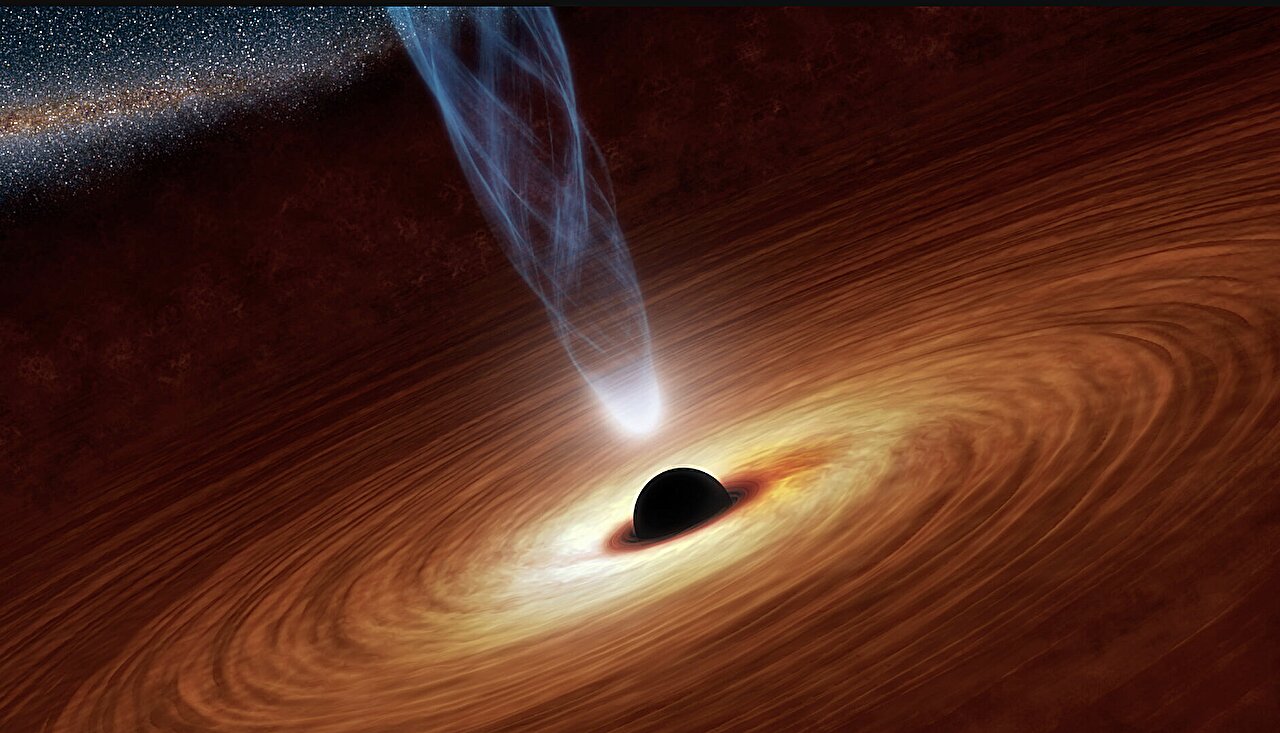
New research suggests that quantum corrections to Einstein's theory of gravity could lead to new solutions for black holes, potentially offering a pathway to understanding quantum gravity, the long-sought unification of general relativity and quantum physics, although experimental verification remains challenging.
A theoretical study conducted by researchers at the University of California–Santa Barbara, University of Warsaw, and University of Cambridge suggests that extremal Kerr black holes, a type of uncharged stationary black hole, could serve as "amplifiers" of new and unknown physics. The study shows that the higher-derivative terms in a gravitational effective field theory (EFT) can lead to singularities on the horizons of these black holes, with infinite tidal forces. The researchers found that the spacetime geometry near the horizon of extremal black holes is sensitive to new physics at higher energies, potentially breaking down the low-energy description of physics. This research opens up possibilities for exploring new physical phenomena and understanding the behavior of black holes.