
Tag

Pol Ii

All articles tagged with #pol ii

Cryo-EM maps reveal how influenza polymerase snatches caps from host transcripts
science3 hours ago

Cryo-EM maps reveal how influenza polymerase snatches caps from host transcripts

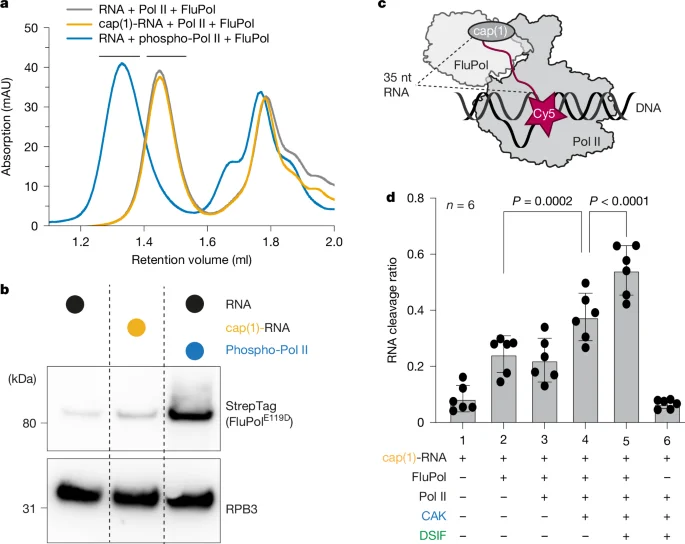
New cryo-EM structures show influenza polymerase (FluPol) binds a transcribing host Pol II–DSIF complex to perform cap snatching. The PA endonuclease sits near the Pol II RNA exit, DSIF stabilizes the interaction, and the capped RNA is channeled from the cap-binding domain to the endonuclease before cleavage. After cleavage, the 3′ end of the primer is directed toward FluPol’s polymerase active site, yielding a primer ready for transcription initiation in a state that resembles the pre-initiation complex. Mutations at FluPol–Pol II–DSIF interfaces reduce polymerase activity in cells, defining a three-step mechanism and a window during early transcription when cap snatching can occur. These findings clarify how host transcription is hijacked for viral mRNA synthesis and suggest targets for antiviral strategies.


German Scientists Uncover Breakthrough in Anti-Aging Research
science2 years ago

German Scientists Uncover Breakthrough in Anti-Aging Research

Researchers from the University of Cologne in Germany have discovered that gene transcription becomes faster with age but less precise and more error-prone, leading to bad copies that can cause numerous diseases. They found that low-calorie diets and inhibiting insulin signalling could slow down the speed of Pol II and reduce the number of faulty copies. The findings could help prevent cancer and allow us to better understand ageing, ultimately opening up new opportunities for delaying ageing or expanding healthy ageing.

Rethinking the Limits of Human Lifespans: German Scientists Discover Anti-Aging Breakthrough
science2 years ago

Rethinking the Limits of Human Lifespans: German Scientists Discover Anti-Aging Breakthrough

Researchers from the University of Cologne have discovered that gene transcription becomes faster with age but less precise and more error-prone, leading to numerous diseases. They found that low-calorie diets and inhibiting insulin signalling could delay ageing and extend lifespan in many animals. The investigation first worked with worms, mice and fruit flies genetically modified to inhibit insulin signalling as well as with mice on a low-calorie diet to determine the performance of cell transcription in old age. The findings could help prevent cancer from manifesting and ultimately better understand interventions for delaying ageing or expanding healthy ageing.